Updated June 2026 · Home Insurance Guide · 15 min read
A complete, plain-English timeline of every stage in the home insurance claims process, the state-by-state legal deadlines insurers must follow, what 2026 industry data says about how fast claims are actually moving, and how to avoid the most common delays.
Quick Summary
Most straightforward home insurance claims take 2 to 6 weeks from filing to payment. Complex claims involving major structural damage or disputes can take several months or longer.
In 2025, the average time to receive a final claim payment stretched to 44 days after the initial loss notice, according to J.D. Power’s national claims study.
The good news for 2026: J.D. Power’s newest study found claims are now being fully resolved 3.4 days faster than the prior year, driven by improved digital tools and faster repair scheduling.
Every state sets its own legal deadlines for insurers to acknowledge, accept or deny, and pay a claim, ranging from as fast as 5 business days for payment in Texas to up to 90 days in Florida during a declared emergency.
California introduced the Disaster Recovery Reform Act in 2026, aimed directly at speeding up claims for wildfire survivors after widespread reports of delays following the January 2025 Los Angeles fires.
The single biggest factor in how fast your claim moves is documentation: thorough photos, a home inventory, and a fast initial report all measurably shorten the timeline.
1. The Home Insurance Claims Timeline, Step by Step
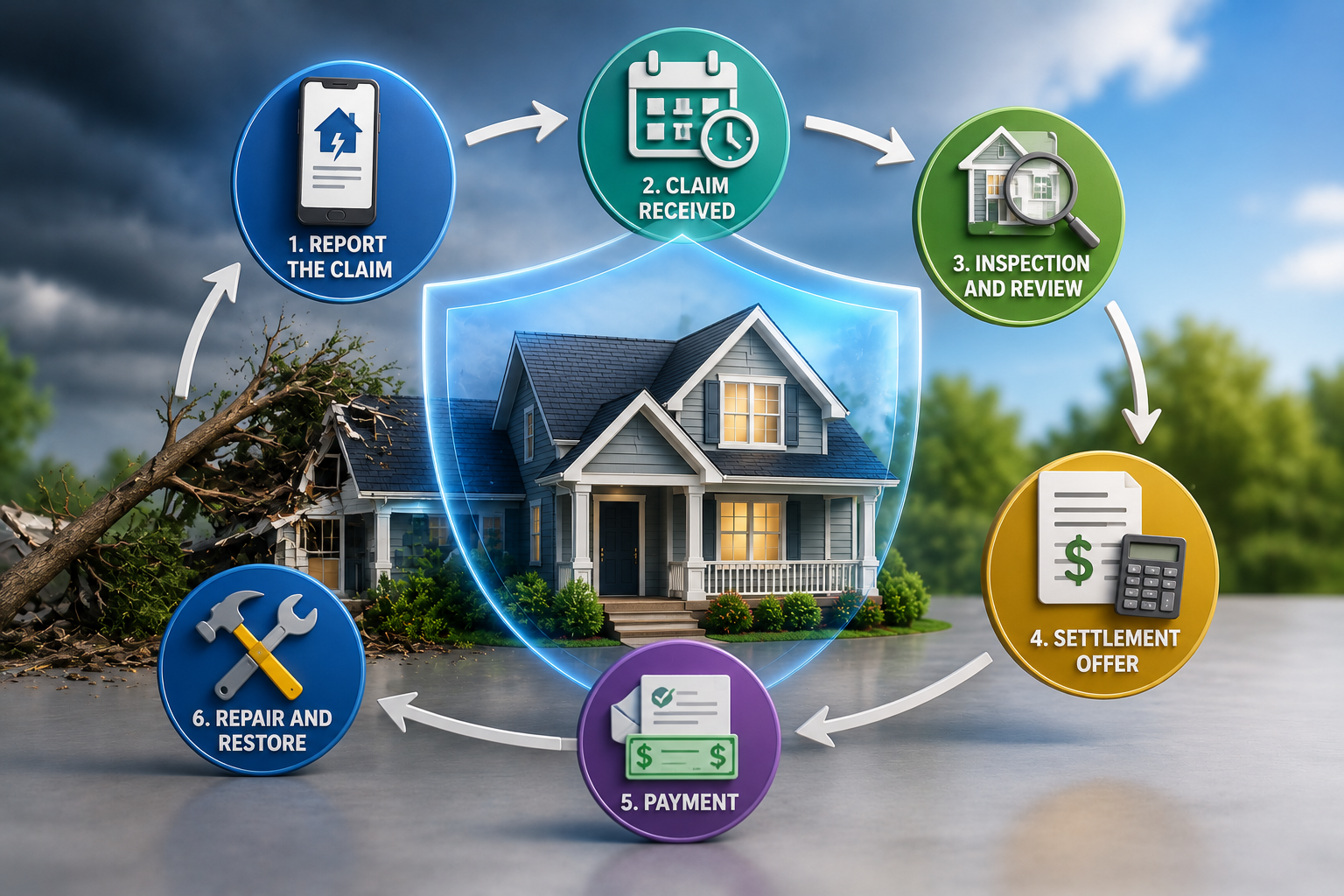
Every home insurance claim moves through the same basic sequence, regardless of the insurer or the type of damage. Understanding each stage helps you know what is normal and what might signal an unnecessary delay.
1
Report the LossUsually completed the same day, often online or by phone in minutes.
2
Claim AcknowledgmentInsurer confirms receipt, typically within 24 to 48 hours, though state law may allow up to 15 days.
3
Adjuster Assigned and Inspection ScheduledUsually within a few days to two weeks, longer during widespread disasters.
4
Investigation and Documentation ReviewCan take days to several weeks depending on damage complexity and how quickly you supply requested documents.
5
Claim Decision: Accepted, Partially Accepted, or DeniedState law typically requires this within 15 to 40 business days after all documentation is received.
6
Settlement Offer and NegotiationCan be immediate for simple claims, or take additional weeks if you dispute the initial estimate.
7
Payment IssuedMost states require payment within 5 to 30 business days after you accept the settlement.
8
Repairs Completed and Final Payment (if applicable)Varies entirely based on contractor availability and the extent of repairs; can take weeks to many months.
2. How Long Each Stage Actually Takes
While the steps above are consistent, the actual time spent in each stage varies widely. The table below reflects typical ranges reported across the industry in 2026.
Stage
Typical Timeframe
Initial report to acknowledgment
Same day to 48 hours
Adjuster inspection scheduled
3 days to 2 weeks
Investigation phase
1 to 4 weeks
Accept or deny decision
2 to 6 weeks
Payment after acceptance
5 business days to 30 days
Total for a straightforward claim
2 to 6 weeks
Total for a complex or disputed claim
Several months to over a year
3. State-by-State Legal Deadlines for Insurers
Unlike many consumer protections, insurance claim deadlines are set at the state level, not federally, which means your timeline can look very different depending on where you live. Below are examples from several of the most populous states.
State
Acknowledge Claim
Accept or Deny
Pay After Acceptance
Texas
15 business days
15 business days after full documentation (up to 45 with written reason)
5 business days
California
15 calendar days
40 days after proof of loss
30 days after acceptance (typical)
Florida
14 calendar days
60 days (90 days during a declared state of emergency)
Varies; undisputed portions must be paid promptly
Minnesota
10 business days
Prompt decision required
5 business days
Mississippi / Virginia
No fixed statutory deadline
No fixed statutory deadline
No fixed statutory deadline
Why this matters: If your insurer misses these statutory deadlines, most states allow you to file a complaint with your state insurance commissioner, and several states, including Texas, allow interest and attorney’s fees to accrue against the insurer for unreasonable delays. Knowing your state’s specific deadlines gives you a concrete benchmark to point to if your claim seems to be stalling without explanation.
4. 2026 News: Claims Are Getting Faster, But Disasters Still Cause Delays
2026 News Update: According to the J.D. Power 2026 U.S. Property Claims Satisfaction Study, released in March 2026, homeowners insurance claims are now being fully resolved 3.4 days faster than the previous year, driven by faster repair cycle times, quicker payment processing, and expanded digital claim-filing tools. The study, based on more than 5,000 homeowners who filed claims in the prior nine months, found that a relatively calmer hurricane season and fewer large-scale weather events in 2025 also contributed to the improvement, even as premiums and deductibles continued to rise nationally.
That improvement follows a difficult stretch. The prior year’s J.D. Power study had found that the average time to receive a final claim payment had stretched to 44 days after the initial loss notice, with insurers describing financial strain from a string of catastrophic years; 27 separate billion-dollar weather disasters struck the U.S. in 2024 alone, following 28 such events in 2023.
Disaster-driven delays remain a significant and ongoing concern in catastrophe-exposed states. Following the devastating January 2025 Los Angeles wildfires, California’s insurance department received a wave of complaints from wildfire survivors citing delays, denials, and unclear communication from insurers. In response, California’s insurance commissioner and a state senator introduced the Disaster Recovery Reform Act in 2026, specifically aimed at modernizing decades-old claims-handling laws and speeding up the recovery process for wildfire and winter storm survivors going forward.
5. What Makes a Claim Take Longer
Widespread catastrophes. When thousands of neighbors file claims from the same storm or wildfire simultaneously, adjuster availability becomes the primary bottleneck, regardless of how simple any individual claim is.
Incomplete documentation. Missing photos, receipts, or a home inventory forces the insurer to request additional information, which restarts parts of the clock.
Disputed damage estimates. If you and the adjuster disagree on the scope or cost of repairs, resolving that gap, sometimes through a second inspection or appraisal, adds real time.
Contractor and material availability. Even after a claim is approved, repairs cannot finish faster than a contractor’s schedule allows, and material shortages after a regional disaster can extend this significantly.
Mortgage company involvement. If you have a mortgage, larger claim checks are often made out jointly to you and your lender, adding an extra administrative step before funds are released for repairs.
Coverage disputes. Questions about whether a specific cause of damage is actually covered, such as a gradual leak versus a sudden pipe burst, can require additional investigation or even legal review.
6. Claim Timelines by Type of Damage
Damage Type
Typical Resolution Time
Minor water leak, caught early
1 to 3 weeks
Wind or hail damage to roof
2 to 6 weeks
Theft or vandalism
2 to 4 weeks
House fire, partial damage
1 to 4 months
House fire, total loss
4 to 12+ months
Major regional disaster (hurricane, wildfire)
3 months to over a year
A minor water leak that is caught quickly and clearly documented is often one of the fastest claims to resolve, while a total-loss fire claim involves a far more detailed inventory and valuation process, plus the additional time needed to rebuild rather than simply repair.
7. What Happens During a Catastrophe or Natural Disaster
Large-scale events change the claims process in several specific ways that are worth understanding before you ever need to file.
Catastrophe teams deploy. Insurers send dedicated catastrophe adjusters to the affected region, sometimes including out-of-state adjusters brought in temporarily.
State deadlines may extend. Florida, for example, extends its standard 60-day claim decision window to 90 days during a declared state of emergency. Texas allows similar extensions during major disasters.
Triage by severity. Claims involving uninhabitable homes or safety hazards are generally prioritized ahead of claims involving cosmetic or lower-urgency damage.
Advance payments. Many insurers issue a partial advance payment for additional living expenses or emergency repairs before the full claim is finalized.
Increased scrutiny on large losses. Total-loss claims after a wildfire or hurricane often require a more detailed home inventory and valuation process specifically because the dollar amounts involved are much larger.
8. How to Speed Up Your Own Claim
Report the loss immediately. Most policies require notice “as soon as reasonably possible,” and early reporting starts every subsequent deadline sooner.
Photograph and video everything before cleanup. Wide shots and close-ups of all damage, taken before anything is moved or repaired, are the single most useful piece of evidence you can provide.
Keep a home inventory updated year-round. A pre-existing list of belongings with photos and approximate values dramatically shortens the personal property portion of a claim.
Respond to information requests quickly. Many of the statutory clocks described in Section 3 only start once the insurer has received all requested documentation from you.
Make necessary emergency repairs. Tarping a damaged roof or shutting off a leaking pipe is usually required by your policy to prevent further damage, and most insurers reimburse reasonable emergency repair costs.
Use your insurer’s digital claim tools. 2026 industry data shows that insurers with stronger digital claim-filing and tracking tools are now producing measurably faster resolution times.
Keep a written log of every call and email. Dates, names, and summaries of conversations create a clear record if you need to escalate a stalled claim later.
9. What to Do If Your Claim Is Taking Too Long
Compare your timeline against your state’s legal deadlines from Section 3. If your insurer has missed a statutory deadline, say so directly and in writing.
Request a written status update if you have gone more than two to three weeks without meaningful communication.
File a complaint with your state insurance department if you believe your insurer is acting in bad faith or simply stalling without explanation.
Consider a public adjuster for large or disputed claims; they work on your behalf rather than the insurer’s, typically for a percentage of the settlement.
Consult an attorney for major losses, particularly total-loss claims or claims where the insurer has denied coverage you believe is valid.
Document the financial impact of the delay, including additional living expenses, since several states allow recovery of these costs when delays are found unreasonable.
10. Frequently Asked Questions
What is the fastest a home insurance claim can be paid?
For very simple, undisputed claims with complete documentation, payment can sometimes arrive within one to two weeks of filing. States like Texas require payment within just 5 business days once a claim is formally accepted.
Why do total-loss claims take so much longer than partial-damage claims?
Total-loss claims require a complete valuation of the structure and every personal belonging lost, plus a more detailed review process given the much larger dollar amounts involved, which adds considerable time compared to a straightforward repair estimate.
Does filing my claim online instead of by phone make it faster?
In many cases, yes. 2026 industry data shows that insurers with stronger digital claim-filing and status-tracking tools are achieving measurably faster resolution times, partly because online filing reduces initial data-entry delays.
Can my mortgage lender delay my claim payment?
Yes, in a sense. For larger claims, payment is often issued jointly to you and your mortgage lender, and the lender may require an inspection or hold a portion of funds until repairs are verified, which can add administrative time even after the insurer has approved the claim.
What happens if my insurer ignores my state’s claim deadline?
Most states allow you to file a complaint with the state insurance department, and several states permit interest charges or attorney’s fees to accrue against an insurer for unreasonable delays, though the specific remedy depends on your state’s laws.
Are claims slower after a major hurricane or wildfire?
Generally yes, simply due to volume. When thousands of claims are filed from the same event at once, even efficient insurers face longer adjuster wait times, though several states extend their legal decision deadlines specifically to account for this reality.
This article is for general educational purposes and does not constitute insurance, legal, or financial advice. Claim deadlines, procedures, and timelines vary by insurer, state, and policy. Always review your specific policy documents or speak with a licensed insurance agent or attorney for advice tailored to your situation.