Updated June 2026 · Home Insurance Guide · 16 min read
A complete breakdown of every major coverage in a standard homeowners policy, the most common exclusions that catch homeowners off guard, and what rising 2026 premiums and non-renewals mean for your coverage decisions this year.
Quick Summary
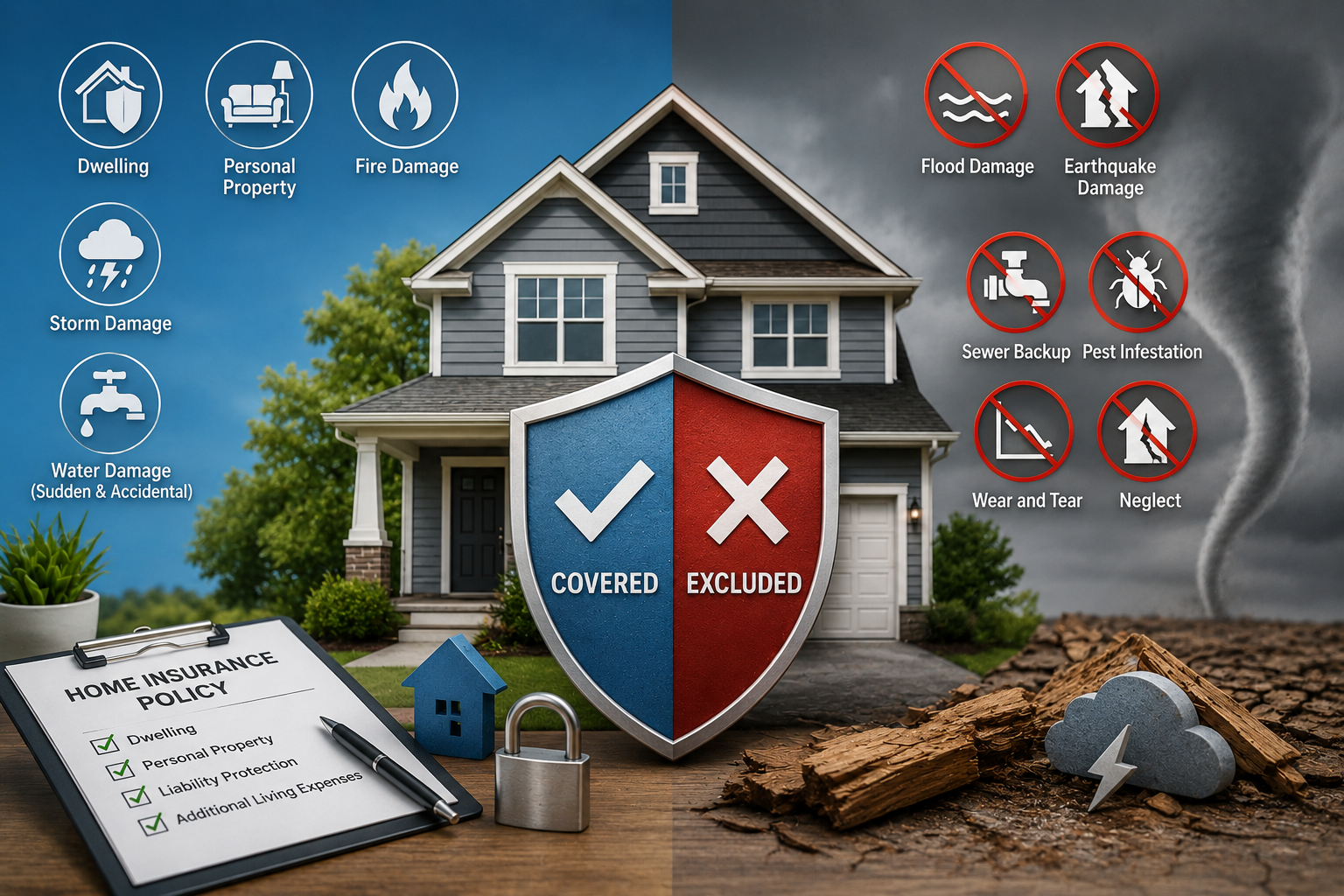
A standard homeowners policy (most often an HO-3) covers five core areas: dwelling, other structures, personal property, liability, and loss of use (additional living expenses).
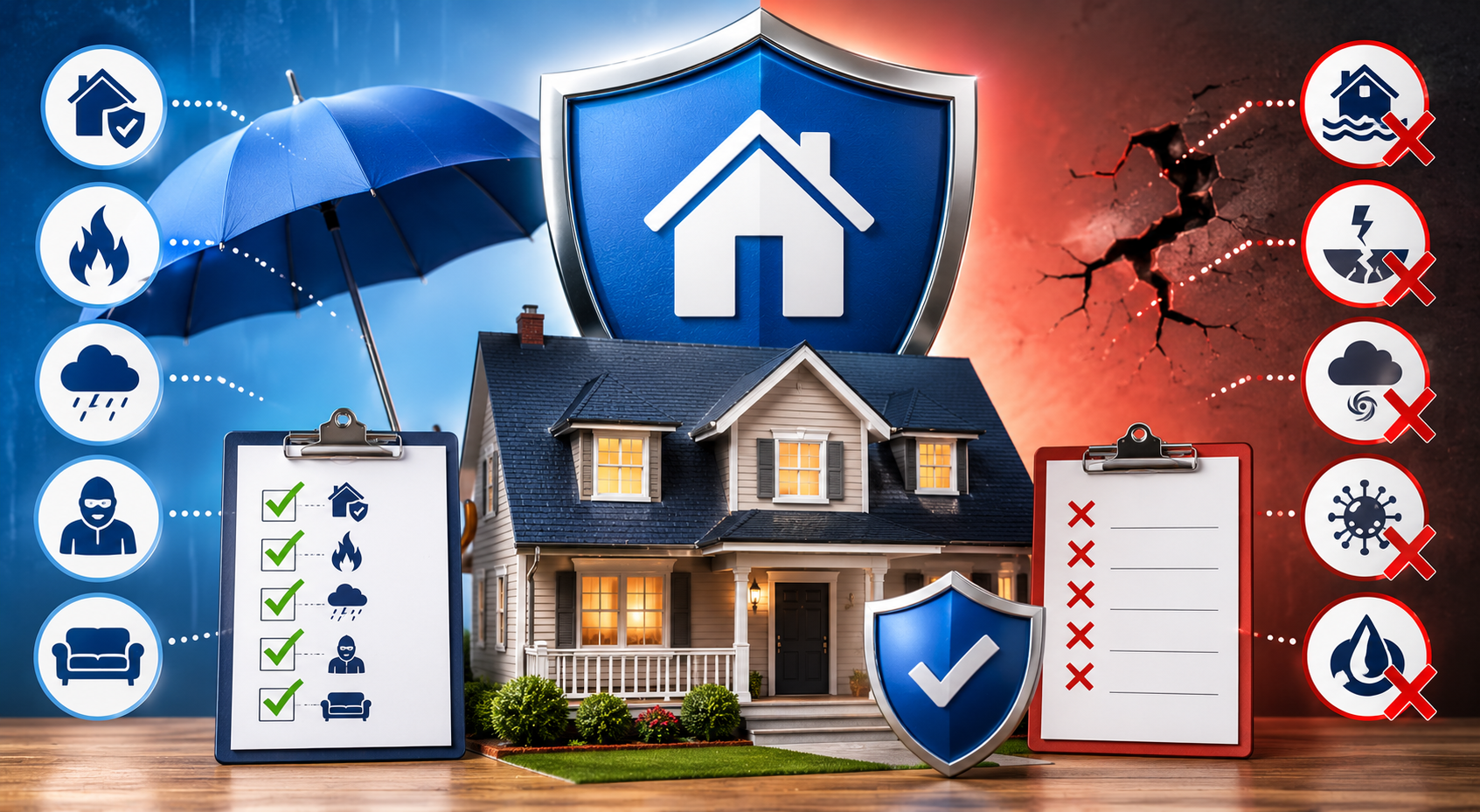
Covered perils typically include fire, lightning, windstorm, hail, theft, vandalism, falling objects, and certain types of sudden water damage.
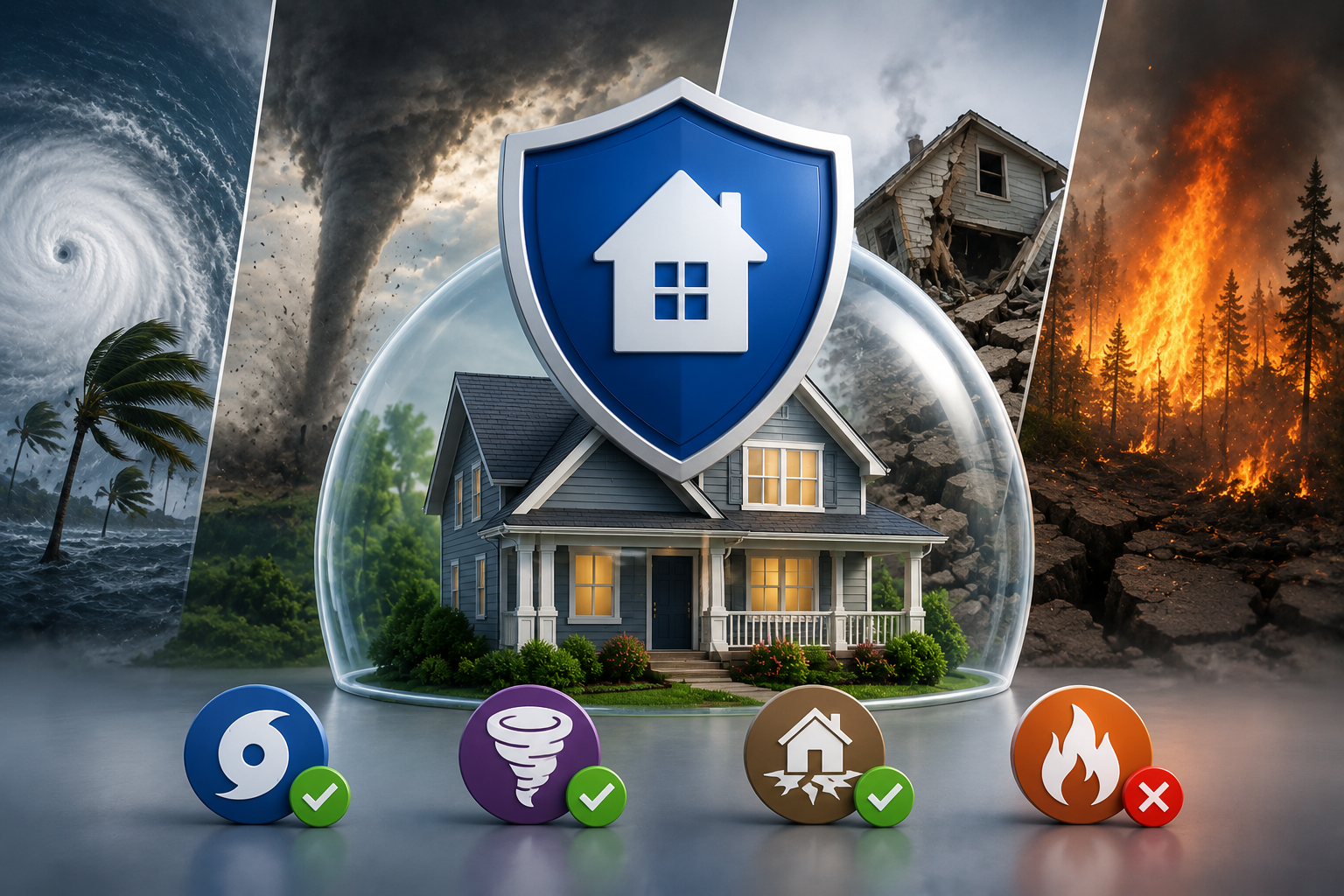
Flood and earthquake damage are excluded from every standard policy in the United States and require separate coverage.
Other common exclusions include sewer backup, gradual wear and tear, pest damage, mold from neglect, and business activities run from the home.
One-third of Americans with homeowners insurance reported a premium increase in the past year, according to a 2026 NerdWallet survey, with wildfire, hail, and hurricane-prone regions seeing the steepest hikes.
New California consumer-protection laws took effect January 1, 2026, expanding wildfire mitigation grants and strengthening non-renewal protections after the historic 2025 Los Angeles wildfires.
High-value items like jewelry, art, and collectibles are subject to low built-in policy limits and often need a separate scheduled endorsement for full protection.
Most homeowners policies, regardless of insurer, are built from the same six coverage blocks. Understanding each one is the fastest way to know exactly what you are paying for.
Coverage
What It Protects
Coverage A: Dwelling
The physical structure of your home, including attached garages
Coverage B: Other Structures
Detached garages, sheds, fences, and other structures not attached to the home
Coverage C: Personal Property
Furniture, electronics, clothing, and other belongings inside the home
Coverage D: Loss of Use
Hotel bills and extra living expenses if your home becomes uninhabitable after a covered loss
Coverage E: Personal Liability
Legal and medical costs if someone is injured on your property and you are found responsible
Coverage F: Medical Payments
Smaller medical bills for guests injured on your property, regardless of fault
Coverage B, other structures, is typically set at around 10 percent of your dwelling coverage limit automatically, though this can be adjusted. Coverage D, loss of use, is often the most overlooked until a homeowner actually needs it, since it is the coverage that pays for a hotel or rental home while repairs are underway after a covered fire or storm.
2. Covered Perils: What Triggers a Payout
Most standard policies, particularly the common HO-3 form, provide “open peril” coverage for the dwelling itself. This means the structure is covered for any cause of loss except for the specific exclusions listed in the policy. Personal property, on the other hand, is usually covered on a “named peril” basis, meaning only the perils specifically listed in the policy apply.
Perils typically covered for both dwelling and personal property
Fire and smoke damage
Lightning strikes
Windstorm and hail
Explosions
Theft and vandalism
Falling objects, such as tree limbs
Weight of ice, snow, or sleet
Sudden and accidental water damage, such as a burst pipe
Damage from vehicles or aircraft
Riot and civil commotion
Important distinction: “Open peril” does not mean “all peril.” Even open peril dwelling coverage still excludes the specific perils named later in the policy, most notably flood, earthquake, and neglect. The open peril structure simply shifts the burden of proof: instead of you proving your loss matches a listed peril, the insurer must prove your loss matches a listed exclusion.
3. Major Exclusions Every Homeowner Should Know
Every standard homeowners policy, regardless of carrier, excludes a consistent set of risks. Some of these are handled through separate insurance policies entirely, while others are simply not insurable risks at all.
Typically Covered
House fire from any accidental cause
Tree falling on the roof during a storm
Theft of belongings from inside the home
Pipe bursting suddenly from a freeze
Vandalism by a third party
Always Excluded
Flooding from outside the home
Earthquake and earth movement
Normal wear and tear or neglect
War and nuclear hazard
Intentional damage by the homeowner
The most commonly misunderstood exclusions
Flood damage. Water rising from outside the home, including storm surge and overflowing rivers, is excluded from every standard policy in the country and requires a separate National Flood Insurance Program or private flood policy.
Earthquake and earth movement. Damage from earthquakes, sinkholes, landslides, and mudslides is excluded and requires a separate endorsement or standalone policy, which is especially relevant in seismic states like California and parts of the Pacific Northwest.
Sewer and drain backup. Water that backs up through a drain or sewer line, or a sump pump that overflows, is excluded unless a specific water backup endorsement has been purchased.
Wear and tear and gradual deterioration. A roof that leaks because it is old and was never maintained is treated very differently from a roof that suddenly fails during a storm.
Pest and rodent damage. Termites, carpenter ants, and rodent infestations are considered a maintenance issue, not a sudden loss, and are excluded.
Business activities conducted from the home. Liability and equipment connected to running a business out of your home generally need a separate business policy or endorsement.
High-value items beyond policy sub-limits. Jewelry, fine art, and collectibles are typically capped at a low default limit, often a few thousand dollars total, regardless of their actual value.
4. Dwelling Coverage: Actual Cash Value vs Replacement Cost
How your dwelling coverage pays out after a covered loss depends on which valuation method your policy uses, and the difference between these methods can mean tens of thousands of dollars.
Valuation Type
How It Works
Actual Cash Value (ACV)
Pays the replacement cost minus depreciation. An older roof is worth less in a payout than a brand-new one.
Replacement Cost Value (RCV)
Pays the full cost to rebuild or repair with similar materials, without subtracting depreciation.
Guaranteed or Extended Replacement Cost
Pays the full rebuild cost even if it exceeds your stated policy limit, often up to a set percentage above the limit.
Most homeowners are better served by replacement cost coverage, since construction material and labor costs have risen sharply in recent years, and an actual cash value payout on an older home can leave a significant gap between the payout and the true cost to rebuild.
5. Personal Property Limits and High-Value Items
Personal property coverage is usually set as a percentage of your dwelling coverage, commonly between 50 and 70 percent. Within that overall limit, insurers also apply specific sub-limits to categories of high-value items that are easy to overlook until a claim is denied or only partially paid.
Item Category
Typical Default Sub-Limit
Jewelry and watches
$1,000 – $2,500 total
Cash and currency
$200 – $500
Firearms
$2,000 – $3,000
Fine art and collectibles
Often excluded above a low cap without a rider
Electronics (business use)
Limited or excluded; needs a business rider
Homeowners with an engagement ring, a coin collection, or expensive camera equipment frequently discover these sub-limits for the first time only after filing a claim. A scheduled personal property endorsement, sometimes called a rider, removes the cap for a specifically appraised and listed item.
6. 2026 News: Rising Rates, Non-Renewals, and New Laws
2026 News Update: A 2026 NerdWallet survey found that roughly one-third of Americans carrying homeowners insurance, 34 percent, reported a premium increase in the past 12 months, with severe weather and natural disasters cited as a contributing factor by 21 percent of respondents nationwide. There were 27 separate disasters in 2024 that each caused at least one billion dollars in damage, a trend that insurers say continues to push base rates higher even in regions far from coastlines.
The pressure is most visible in catastrophe-exposed states. Following the historic January 2025 Palisades and Eaton wildfires in the Los Angeles area, California’s insurance market saw a wave of non-renewals and rate filings; some carriers pursued combined increases totaling around 30 percent or more, citing extreme wildfire losses and reinsurance strain. In response, a set of new California consumer-protection laws took effect on January 1, 2026, including a wildfire safety grant program intended to help residents fund fire-resistant roofing and “Zone Zero” defensible-space upgrades, along with expanded non-renewal protections and faster claim payout requirements for wildfire survivors.
The pattern is not limited to wildfire states. Severe convective storms, the category that includes hail, tornadoes, and straight-line wind, now generate annual cumulative losses that rival a single major hurricane in some years, and Midwest states such as Minnesota have seen meaningful rate increases driven specifically by this hail and wind exposure rather than wildfire or hurricane risk. Hawaii’s insurance market faced a similarly sharp shock after the 2023 Lahaina wildfires, with non-renewal rates reported to have risen by roughly 200 percent in the aftermath, prompting state lawmakers to explore a public insurer-of-last-resort option.
7. Common Endorsements That Fill the Gaps
An endorsement, sometimes called a rider, is an add-on to a standard policy that restores or adds coverage for a specific excluded risk. These are generally far cheaper than a standalone policy and are one of the most underused tools available to homeowners.
Endorsement
What It Adds
Water backup / sump pump overflow
Covers sewer and drain backups, normally excluded
Scheduled personal property
Removes sub-limits for specific appraised jewelry, art, or collectibles
Ordinance or law coverage
Pays the extra cost to rebuild to current building codes after a major loss
Service line coverage
Covers damage to underground utility or sewer lines on your property
Equipment breakdown
Covers sudden mechanical or electrical failure of major home systems
Home business endorsement
Extends liability and equipment coverage for a home-based business
8. Policy Types Compared: HO-1 Through HO-8
Not every homeowners policy is structured the same way. The letter-number designation tells you how broad the coverage actually is.
Policy Form
Best For
Coverage Style
HO-1
Rarely sold today
Named perils only, very limited; largely phased out
HO-2
Budget-conscious buyers
Broad named perils on dwelling and property
HO-3
Most homeowners (the most common policy in the U.S.)
Open peril dwelling, named peril personal property
HO-5
Higher-value homes
Open peril on both dwelling and personal property
HO-6
Condo owners
Covers interior unit and belongings; building covered by HOA policy
HO-7
Mobile and manufactured homes
Similar structure to HO-3, adapted for manufactured housing
HO-8
Older or historic homes
Actual cash value basis, often used when replacement cost would be impractical
9. Specific Situations: Mold, Pests, Pools, and Home Business
Mold
Mold caused directly by a sudden, covered event, such as a burst pipe that is addressed quickly, is often covered up to a stated limit. Mold resulting from a long-ignored leak or chronic humidity problem is treated as a maintenance failure and is typically excluded.
Pests and rodents
Termite damage, carpenter ant infestations, and rodent damage are considered preventable through routine pest control and inspection, so they are excluded from virtually every standard policy.
Swimming pools and trampolines
Damage to a pool itself from a covered peril like a falling tree is often covered under other structures, but liability exposure from these “attractive nuisance” features can be significant. Many insurers require specific fencing, covers, or liability riders before extending full coverage.
Home-based businesses
A standard homeowners policy provides only minimal coverage for business equipment and explicitly excludes business liability. Anyone running even a small home-based business, including frequent client visits or business inventory stored at home, should ask their agent about an in-home business endorsement or separate business owner’s policy.
Dog bites and pet liability
Liability coverage typically extends to dog bite claims, with limits commonly ranging between 100,000 and 300,000 dollars depending on the policy. Some insurers exclude specific breeds or require an additional liability rider after a prior bite incident.
10. How to Read Your Policy Before You Need To
Find your declarations page first. This single page summarizes your coverage limits, deductible, and policy period at a glance.
Check Coverage A against current rebuild cost, not market value, since land value does not factor into rebuilding a structure.
Look for the word “named” versus “open” in the perils section to understand whether your personal property is broadly or narrowly covered.
Search the exclusions section for flood, earthquake, and sewer backup to confirm whether you already have any of these added back through an endorsement.
Note your deductible structure. Many policies in catastrophe-prone states now apply a separate, often percentage-based deductible specifically for wind, hail, or hurricane losses.
Review your personal property sub-limits against an actual home inventory, especially for jewelry, electronics, and collectibles.
11. Tips to Close Coverage Gaps Without Overpaying
Get flood insurance even outside a designated flood zone if you live near any body of water or in an area with poor drainage; roughly a third of flood claims nationally come from outside high-risk zones.
Add water backup coverage. It is one of the cheapest, highest-value endorsements available, typically $50 to $250 per year.
Schedule high-value items individually rather than relying on the default personal property sub-limits.
Raise your deductible if you have an emergency fund. Raising a deductible from $1,000 to $2,500 can lower premiums by roughly 9 percent on average, according to 2026 rate analysis.
Bundle home and auto policies with the same carrier, which often produces a meaningful multi-policy discount.
Ask about mitigation discounts. Wildfire-resistant roofing, storm shutters, and updated electrical or plumbing systems can lower both your risk and your premium.
Shop your policy annually. Comparing at least three quotes at renewal is one of the most consistently effective ways to offset rising base rates.
Watch for non-renewal notices and respond immediately. In high-risk regions, a lapse in coverage can make it significantly harder and more expensive to get reinsured later.
12. Frequently Asked Questions
Does homeowners insurance cover everything that happens to my house?
No. Standard policies cover a wide range of sudden, accidental perils, but explicitly exclude flood, earthquake, normal wear and tear, pest damage, and several other categories that require separate coverage or endorsements.
What is the difference between named peril and open peril coverage?
Named peril coverage only applies to the specific causes of loss listed in the policy. Open peril coverage applies to any cause of loss except for those specifically excluded, which generally provides broader protection.
Is normal wear and tear ever covered?
No. Insurance is designed to cover sudden, unexpected losses, not the predictable, gradual decline of a home’s systems and materials over time. Routine maintenance remains the homeowner’s responsibility.
Do I need a separate policy for earthquakes?
In nearly all cases, yes. Earthquake coverage is excluded from standard homeowners policies and must be purchased as a separate policy or added through an endorsement, which is particularly relevant for homeowners in California and other seismically active regions.
Why did my premium go up even though I never filed a claim?
Insurers set base rates using regional risk data, inflation in construction and labor costs, and reinsurance pricing, not solely individual claims history. A wave of claims from neighbors during a regional disaster can raise base rates for an entire area.
Can my insurer cancel my policy without notice?
Insurers generally must provide advance written notice before a non-renewal or cancellation, with specific notice periods set by state law. Several states have recently strengthened these notice requirements, particularly in wildfire and hurricane-prone regions.
This article is for general educational purposes and does not constitute insurance, legal, or financial advice. Coverage details, exclusions, and endorsement availability vary by insurer and state. Always review your specific policy documents or speak with a licensed insurance agent for advice tailored to your situation.