Updated June 2026 · Auto Insurance Guide · 14 min read
A complete, plain-English breakdown of what your auto policy actually pays for when wind, hail, flooding, or falling trees damage your car, plus the deductible math, claim steps, and the 2026 storm data every driver should know.
Quick Summary
Comprehensive coverage — not liability, not collision — is the part of your auto policy that pays for hail, wind, flood, and falling tree damage to your own vehicle.
If you only carry state-minimum liability insurance, storm damage to your car comes entirely out of your own pocket.
2025 was the third straight year that severe convective storms (hail, tornadoes, and high wind) caused more than $50 billion in insured U.S. losses, according to the Insurance Information Institute.
Roughly 43.5 million U.S. properties now sit in moderate-or-higher hail risk zones, and hail-prone states like Texas still have nearly half of all drivers with no comprehensive coverage at all.
Your deductible (typically $250 to $1,000) applies to every storm claim, so small dent damage often costs less to pay out of pocket than to file.
Paintless dent repair (PDR) is usually the cheapest fix for hail dents and is what most insurers prefer to approve first.
A single severe hailstorm can now generate insured losses comparable to a major hurricane, according to 2026 catastrophe modeling data.
“Storm damage” is a broad umbrella term insurers use to describe vehicle damage caused by weather events rather than a collision. It includes a wide range of scenarios that have nothing to do with another driver or a fender-bender:
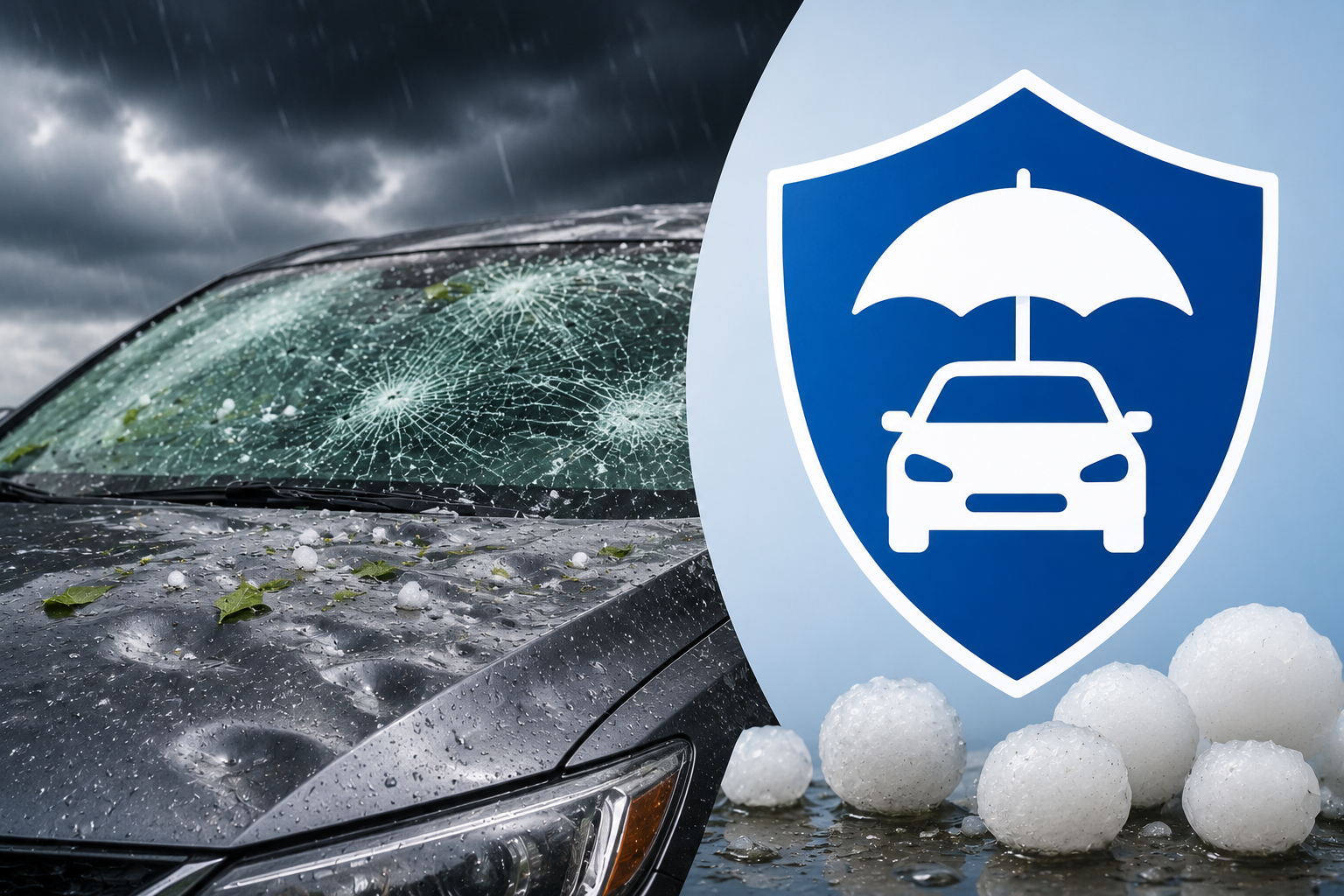
Hail damage — dents in the hood, roof, and trunk; cracked or shattered windshields and windows; chipped or stripped paint.
Wind damage — broken side mirrors, torn convertible tops, damage from flying debris like branches or signage.
Flood and water damage — water intrusion into the engine, electronics, or cabin during flash flooding or storm surge.
Falling object damage — trees, branches, or power lines that come down onto a parked or moving vehicle.
Lightning damage — electrical system failures or fire caused by a direct or indirect lightning strike.
Tornado damage — anything from broken glass to a total loss after a vehicle is rolled, lifted, or struck by debris.
Every one of these events falls outside the “collision with another vehicle or object you hit” definition, which is why a separate type of coverage exists specifically to handle them.
2. The Coverage That Actually Pays: Comprehensive Explained
The short answer to the headline question is this: your car insurance covers storm and hail damage only if you carry comprehensive coverage. There is no separate “storm insurance” or “hail insurance” add-on in a standard auto policy. It is comprehensive coverage that absorbs the cost, minus your deductible, up to your vehicle’s actual cash value.
Comprehensive coverage is sometimes called “other than collision” coverage in policy paperwork, which is a more accurate description of what it does. It generally responds to:
Hail, wind, and storm damage
Flooding
Fire
Theft and vandalism
Falling objects, including tree limbs
Damage from animals, such as hitting a deer
Glass damage, including a windshield cracked by hail or road debris
Key point: Comprehensive coverage is optional under state law in nearly every state, but lenders and leasing companies almost always require it for as long as you have an outstanding auto loan or lease. Once a car is paid off, many drivers choose to drop comprehensive coverage to save money, which is a decision worth running through the math in Section 6 first.
3. Liability and Collision: What They Do Not Cover
It helps to see exactly where the other two major coverage types stop, since this is where most confusion happens after a storm.
Coverage Type
What It Pays For
Covers Hail or Storm Damage?
Liability
Injuries and property damage you cause to other people in an accident you are at fault for
No
Collision
Damage to your own car from hitting another vehicle, object, or rolling over
No
Comprehensive
Damage to your own car from non-collision events such as weather, theft, fire, and animals
Yes
Uninsured Motorist
Damage caused by a driver with no or insufficient insurance
No
Medical Payments / PIP
Medical costs for you and your passengers after an accident
No
If you carry only the state-minimum liability policy — which is legal to drive with in every state — a hailstorm that dents every panel of your car is entirely your financial responsibility. This is not a rare edge case. According to a 2026 analysis of Texas auto insurance policies, only about 51 percent of Texas drivers carry comprehensive coverage, which means nearly half of all vehicles on Texas roads have zero protection against hail, despite Texas being one of the most hail-active states in the country.
4. 2026 Storm Season: What the Data Shows
Severe weather aimed at vehicles is not a marginal risk anymore. It has become one of the largest cost drivers in the entire auto and property insurance industry, and 2026 data confirms the trend is accelerating rather than leveling off.
2026 News Update: The Insurance Information Institute reported in April 2026 that severe convective storms (a category that includes hail, tornadoes, and straight-line winds) generated more than 51 billion dollars in insured U.S. losses during 2025, the third consecutive year this category has topped 50 billion dollars and a higher total than any other category of natural disaster, including hurricanes. Total economic damage from these storms reached over 68 billion dollars, making 2025 the third-costliest year on record for this peril.
A separate March 2026 catastrophe-risk report found that more than 43.5 million U.S. properties now sit in moderate-or-greater hail risk zones, representing roughly 17.84 trillion dollars in reconstruction value. The same report found that 2025 logged 142 days nationwide with damaging hail, seven more than 2024 and well above the 20-year average of 122 days. During those events, hailstones two inches or larger struck more than 600,000 homes in the U.S., a number that does not even count the vehicles parked outside those homes.
Perhaps the most striking shift in 2026 industry commentary: catastrophe modelers now describe a severe, decades-scale hailstorm as capable of producing close to 30 billion dollars in insured losses on its own, putting hail’s worst-case scenario on par with a major landfalling hurricane. Hail has historically been treated by the industry as a “secondary peril,” a label that increasingly does not match the financial reality.
On the ground, this shows up as elevated claims volume well before peak summer storm season. Major carriers reported that March 2026 storms alone generated more than 50,000 claims across the Midwest, and the spring 2026 season was already producing claims at an elevated pace compared with prior years.
5. How Much Storm and Hail Claims Really Cost
The cost of repairing storm damage depends heavily on the repair method, the number of panels affected, and whether glass or structural components were hit. Two repair paths exist for most hail and dent damage:
Paintless Dent Repair (PDR)
PDR is a technique where trained technicians access the back of a panel and gently massage dents out without disturbing the factory paint. It is faster, cheaper, and preserves the vehicle’s original finish, which is why most insurers prefer it whenever the paint is not broken.
Traditional Body Shop Repair
When paint is cracked, a panel is creased, or the damage is too deep for PDR, a traditional body shop approach involving fillers, sanding, and repainting becomes necessary. This method costs significantly more per panel.
Damage Severity
Paintless Dent Repair (PDR)
Traditional Body Shop
Single small ding
$75 – $200
$300 – $600
Moderate, a few panels
$500 – $1,500
$1,200 – $3,000
Severe, hundreds of dents
$2,500 – $7,500+
$6,000 – $16,000+
Windshield chip repair
$75 – $150
—
Windshield replacement
$300 – $1,500+
—
Industry repair data from a major hail specialist puts the average full-vehicle hail repair around 6,453 dollars in 2026, with a typical range between roughly 2,500 and 16,875 dollars depending on storm severity. One detail that surprises many drivers: even modest, barely visible hail damage can reduce a vehicle’s resale or trade-in value by several thousand dollars, since dealers and buyers run a vehicle history and visual inspection before making an offer.
6. Deductibles: The Math You Need Before You File
Your comprehensive deductible is the amount you pay out of pocket before insurance covers the remainder of an approved repair. Common deductible amounts are 250, 500, and 1,000 dollars, and the deductible applies to every separate claim, not just your first one each year.
This creates a simple but important rule: if your repair estimate is lower than your deductible, filing a claim gets you nothing. You would pay the full repair cost either way, and a claim would still appear on your claims history.
Example 1: Claim is worth filing
Hail estimate: 6,000 dollars. Deductible: 500 dollars. Insurance pays 5,500 dollars; you pay 500 dollars. Filing clearly saves you money.
Example 2: Claim is not worth filing
Hail estimate: 400 dollars. Deductible: 500 dollars. You would pay the entire 400 dollars whether or not you file, since the cost is below your deductible. There is no reason to involve your insurer here.
Example 3: Borderline case
Hail estimate: 600 dollars. Deductible: 500 dollars. Filing nets you only 100 dollars back, and that small payout has to be weighed against the possibility of a rate increase at renewal and a claim appearing on your record for future quotes.
Practical tip: Always get a written repair estimate before deciding whether to file. Many auto glass and PDR shops offer free inspections specifically so you can run this math before contacting your insurer.
7. How to File a Storm or Hail Damage Claim
Move your car to safety. If more weather is forecast, get the vehicle under cover to avoid additional damage before it’s inspected.
Document everything. Take clear photos from multiple angles, including wide shots and close-ups of every dent, crack, or chip.
Get a written repair estimate. A body shop or PDR specialist can usually provide a free estimate, which helps you decide whether filing makes financial sense.
Contact your insurer. Report the date, location, and a description of the weather event, since the claim needs to be tied to a documented event.
Meet the adjuster. An adjuster will inspect the vehicle, evaluate whether PDR or traditional repair is appropriate, and approve a repair estimate.
Choose your repair shop. In most states you are not required to use the insurer’s preferred shop; you can choose your own.
Pay your deductible. The shop bills your insurer directly for the remainder of the approved cost in most cases.
8. Will Filing a Claim Raise Your Rates
This is one of the most common questions drivers ask, and the honest answer is: it depends on the insurer, the state, and your claims history, but it is less likely to raise rates than an at-fault accident claim.
Because comprehensive claims like hail damage are caused by events completely outside the driver’s control, some insurers do not raise individual rates after a single weather-related claim. Industry experts note that a pattern of repeated weather claims is more likely to affect pricing than one isolated event. However, rates can still rise indirectly: if a wide regional storm generates a large volume of claims across your area, insurers may raise base rates for everyone in that zip code at the next renewal cycle to offset the higher payout volume, regardless of whether you personally filed a claim.
Rising repair costs are compounding this effect. Average auto repair costs reached 4,818 dollars in 2025, nearly double the 2,500 dollar average from 2010, according to claims-data firm CCC Intelligent Solutions. That same 2026 report found that 23.1 percent of all auto claims in 2025 resulted in a total loss, the highest share in industry history, driven in part by the rising cost of recalibrating advanced driver-assistance sensors after even minor body repairs.
9. Total Loss: When Storm Damage Exceeds Your Car’s Value
If repair costs plus salvage value exceed a set percentage of your car’s actual cash value, the insurer will declare it a total loss rather than pay for repairs. This threshold, called the Total Loss Formula, varies significantly by state.
State Example
Total Loss Threshold
What It Means
Nevada
50% of vehicle value
A $10,000 car can be totaled at just $5,000 in damage
Texas / Colorado
Repair cost must exceed full value
Harder to trigger total loss; more vehicles get repaired
If your car is totaled, comprehensive coverage pays out the actual cash value at the time of the claim, minus your deductible. If you still owe more on your loan than the car is worth, that gap is not covered by standard comprehensive insurance. This is exactly the situation gap insurance is designed to fill, and it’s worth asking your lender or insurer about if your vehicle is financed and located in a high hail-risk region.
10. State-by-State Hail Risk Snapshot
Hail can technically fall in any state, but certain regions see dramatically higher frequency and severity. The “hail alley” running from Texas through Oklahoma, Kansas, Nebraska, and into the Dakotas remains the most hail-active corridor in the country.
State
Approx. Annual Hail Events
Notable Detail
Texas
~124 per year
Highest total property losses; DFW metroplex sits in the most active corridor
Kansas
~312 per year
Highest event frequency of any state
South Dakota
~134 per year
Home to the largest hailstone ever recorded in the U.S.
Oklahoma
Frequent severe events
Recorded a 6-inch diameter hailstone, among the largest on record
11. How to Protect Your Car Before the Next Storm
Check the forecast. Severe thunderstorm and hail watches are typically issued hours in advance through the National Weather Service.
Seek covered parking. A garage, carport, or even a parking structure significantly reduces hail exposure.
Use a hail cover or thick blankets. If covered parking is not available, a dedicated hail car cover or heavy moving blankets can reduce dent severity.
Avoid flooded roads entirely. Just six inches of moving water can affect vehicle control, and flood damage to electronics and engines is often far more expensive than hail dents.
Review your coverage every year. If you’ve paid off your car and dropped comprehensive coverage, reconsider it if you live in a hail-prone region; the math in Section 6 still applies, but in reverse.
Keep your policy documents accessible. Knowing your deductible amount before a storm hits helps you make a fast, clear-headed decision afterward.
12. Frequently Asked Questions
Does liability-only insurance cover hail damage?
No. Liability coverage only pays for damage and injuries you cause to others. It does not pay for any damage to your own vehicle, including storm or hail damage.
Is flood damage to a car covered the same way as hail damage?
Yes. Flood damage falls under comprehensive coverage, the same category that covers hail, wind, and falling objects, since it is not caused by a collision.
What if my car gets hit by a falling tree during a storm?
This is also covered under comprehensive coverage, whether the tree fell while you were driving or while the car was parked.
Should I always file a claim for hail damage?
Not necessarily. If the repair estimate is close to or below your deductible, filing a claim provides little or no financial benefit and still adds a claim to your history.
Does a hail claim count against me like an at-fault accident?
Generally no. Comprehensive claims are usually treated differently from at-fault collision claims since the cause is outside your control, though a pattern of repeated claims can still affect renewal pricing.
Can I choose my own repair shop for a hail claim?
In most states, yes. Insurers may recommend a preferred shop, but you typically have the right to choose where your car gets repaired.
Is paintless dent repair as good as traditional repair?
For dents where the paint is not cracked, PDR is generally considered equal or better, since it preserves the factory paint finish and is significantly less expensive.
This article is for general educational purposes and does not constitute insurance, legal, or financial advice. Coverage details, deductibles, and total loss thresholds vary by insurer and state. Always review your specific policy documents or speak with a licensed insurance agent for advice tailored to your situation.