Buying car insurance often feels like a balancing act. If you buy too little coverage, you risk financial ruin from a single patch of black ice or a distracted driver. If you buy too much, you waste hundreds of dollars a year that could go toward your savings, your mortgage, or your retirement.
With standard car ownership costs hitting historic highs, finding the sweet spot for your auto insurance policy is essential.
This guide strips away the industry jargon to help you calculate exactly how much car insurance you really need based on your assets, your vehicle’s value, and your personal comfort with risk.
How Much Car Insurance Do You Need?
Input your asset portfolio and vehicle data to receive personalized, independent policy recommendations.
1. Your Asset Profile
2. Vehicle Valuation
(The comprehensive + collision portion of your bill)
Your Personalized Policy Blueprint
Calculated Financial Net Worth:$90,000
Recommended Liability Limits:
100/300/100 Policy
Your current asset pool requires modern mid-tier limits to prevent legal judgments from reaching your home equity or savings.
Comprehensive & Collision Protection:
KEEP FULL COVERAGE
Because you have an active lien or lease on this vehicle, lenders require you to keep full coverage regardless of policy cost equations.
Deductible Calibration Strategy:
Opt for a $1,000 High Deductible
Your strong liquid savings cache allows you to safely assume high upfront risk. Transitioning to a $1,000 deductible will drop your physical coverage premiums by up to 40%.
The Core Components of an Auto Insurance Policy
To understand how much coverage you need, you must break a standard policy down into its component parts. Auto insurance is not a single coverage layer. It is a collection of individual protections that you can scale up or down.
1. Bodily Injury Liability
If you cause an accident, this component pays for the medical bills, emergency care, rehabilitation, and legal defense fees of the other drivers and passengers involved.
2. Property Damage Liability
This pays to repair or replace things you hit with your car. This usually means the other driver’s vehicle, but it also covers city property like lampposts, guardrails, storefronts, and utility poles.
3. Collision Coverage
Unlike liability insurance, collision coverage protects your property. It pays to repair or replace your vehicle if you hit another car, hit a tree, or roll your vehicle over, regardless of who caused the accident.
4. Comprehensive Coverage
Often called “other-than-collision” coverage, this handles damage to your car caused by events outside your control. Examples include vehicle theft, vandalism, animal strikes, cracked windshields, hail, and structural damage from major floods.
State Minimum Laws vs. Real-World Costs
Almost every state requires drivers to carry a baseline level of liability insurance. These state minimum limits are typically written as a series of three numbers, such as 25/50/25.
$25,000 max payout for bodily injury per person in an accident.
$50,000 max total payout for all bodily injuries per accident.
$25,000 max payout for property damage per accident.
While buying state minimum limits keeps you legal on the road for the lowest possible upfront price, relying on them is a major financial gamble.
According to updated safety data from the National Highway Traffic Safety Administration (NHTSA), the average economic cost of a police-reported motor vehicle crash is tens of thousands of dollars, and crashes involving serious injuries or fatalities quickly climb into the hundreds of thousands.
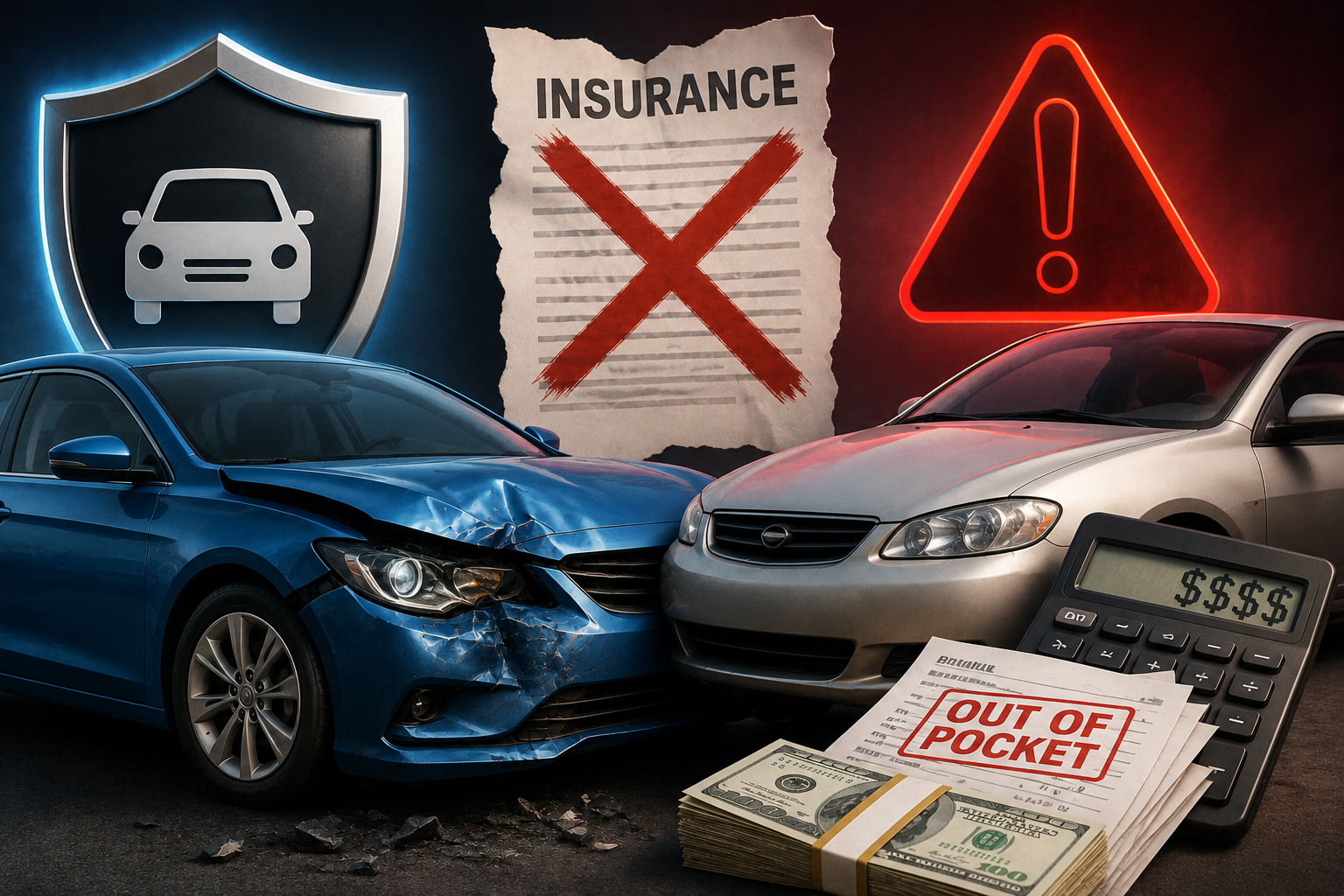
If you carry a $25,000 property damage limit and accidentally total a modern electric SUV worth $65,000, your insurance company will write a check for $25,000 and walk away. You are personally on the hook for the remaining $40,000. The other driver’s insurance company can sue you, garnish your wages, and liquidate your savings to recover that money.
How Much Liability Coverage Do You Really Need?
For the vast majority of drivers, the industry standard recommendation is to carry at least 100/300/100 coverage. If you own a home, have significant retirement savings, or have accumulated personal wealth, you should consider increasing those limits to 250/500/100 or adding an umbrella policy.
Driver Financial Profile
Recommended Liability Limits
Protection Purpose
Students / Minimal Assets
50/100/50
Protects modest savings while keeping premiums manageable.
Average Earners / Families
100/300/100
Protects average home equity and personal savings from lawsuits.
Homeowners / High Net Worth
250/500/100
Safeguards significant real estate holdings and investment portfolios.
The Asset Rule of Thumb
To find your ideal liability target, use this straightforward rule: Your total liability limits should equal or exceed your total net worth.
Add up the value of your savings accounts, investment portfolios, and home equity. If your total net worth is $200,000, a state-minimum policy leaves you exposed. You want a policy with at least $300,000 in total bodily injury coverage to ensure your assets are fully protected in a worst-case legal dispute.
Do You Need Comprehensive and Collision Coverage?
While liability insurance protects your finances from external lawsuits, comprehensive and collision coverages protect the cash value of your actual car.
If you are leasing a vehicle or financing it through a bank, you do not have a choice. Lenders almost always require you to carry full coverage with specific deductible caps to protect their financial investment.
However, if your vehicle is paid off, you have the option to drop comprehensive and collision to save on your monthly premium.
The “10% Rule” for Older Vehicles
To determine whether you should drop full coverage, check your vehicle’s current market value using resources like Kelley Blue Book. Next, check how much you pay annually for your collision and comprehensive coverages combined.
The Rule: If the annual cost of your comprehensive and collision coverages exceeds 10% of your car’s total market value, it is often financially smart to drop full coverage.
For example, if your older sedan is worth $4,000, and keeping full coverage costs you $500 per year with a $1,000 deductible, you are paying $500 annually to protect a maximum potential payout of $3,000 ($4,000 value minus the $1,000 deductible). In this scenario, switching to a liability-only policy and moving those premium savings into an emergency fund is often the wiser choice.
Evaluating Optional Insurance Add-Ons
Insurance companies offer a variety of policy add-ons. Some provide excellent value, while others are unnecessary expenses for the average driver.
This is an absolute necessity. Data from the Insurance Research Council (IRC) indicates that roughly 1 in 8 drivers on the road are completely uninsured. If an uninsured driver hits you, your UM policy steps in to pay your medical bills and repair costs, ensuring you are not stuck paying out of pocket for an accident you did not cause.
2. Gap Insurance
If you purchase a new car with a small down payment, your vehicle will depreciate faster than you can pay down the loan. If your car is totaled, standard collision coverage only pays the current market value of the car. Gap insurance covers the financial gap between what the car is worth and what you still owe on your auto loan. If you owe more than your car is worth, gap insurance is highly recommended.
3. Roadside Assistance and Rental Car Reimbursement
These features are convenient but optional. If you already have a premium credit card or a AAA membership, you likely already have roadside assistance coverage and can safely skip paying for it on your auto policy.
Real-World Math: Deductibles and Premium Impact
Your deductible is the out-of-pocket amount you pay before your insurance coverage kicks in. Choosing the right deductible is a simple way to directly control your monthly premium costs.
According to standard industry quoting matrices, raising your deductible from $250 to $1,000 can reduce your collision and comprehensive premium costs by 20% to 40%.
Deductible Choice
Monthly Premium Cost
Out-of-Pocket Risk
Best Suited For
$250 Low Deductible
High
Very Low
Drivers with limited emergency savings.
$500 Standard
Moderate
Balanced
The average commuter with stable savings.
$1,000 High Deductible
Low
High
Experienced drivers with a dedicated emergency fund.
Before choosing a high deductible, make sure you actually have that cash set aside in a bank account. If your car is damaged and you cannot afford your $1,000 deductible, the repair shop will not release your vehicle, leaving you stranded despite being fully insured.
Action Plan: Tailoring Your Auto Insurance Policy
To make sure your car insurance matches your actual life circumstances, run through this verification checklist once a year:
1.Verify Your State’s Mandatory Minimums: Legal Baseline.
Check your local Department of Motor Vehicles website to identify your area’s absolute minimum liability limits. Use this purely as a starting benchmark, not your final target.
2.Calculate Your Personal Net Worth: Financial Evaluation.
Add up your savings, investments, and home equity, then subtract your debts. Match your total bodily injury and property damage liability limits to this final valuation figure.
3.Check Your Vehicle’s Fair Market Value: Vehicle Valuation.
Look up your car’s value online. If the vehicle is paid off and the annual cost of full coverage is more than 10% of the car’s value, consider dropping down to a liability-only structure.
4.Optimize Your Deductible Limit: Premium Optimization.
If you have a healthy emergency fund, increase your comprehensive and collision deductibles to $1,000 to instantly lower your ongoing premium payments.
Final Thoughts: Finding Financial Balance on the Road
At the end of the day, car insurance is about protecting your financial future. Buying a bare-minimum policy leaves your home, your savings, and your wages vulnerable to legal judgments. On the other hand, over-insuring an older car that has already experienced major depreciation simply drains cash out of your monthly budget.
Review your personal assets, assess the real market value of your vehicle, and work directly with your provider to build a custom, mid-tier policy that delivers true financial security without overcharging your wallet.