Does Life Insurance Cover Accidental Death? Complete 2026 Guide
Quick Answer Summary
Standard life insurance does cover accidental death in most cases. If you die in a car accident, workplace incident, or similar covered accident, your beneficiaries receive the full death benefit.
Accidental Death and Dismemberment (AD&D) is a separate or add-on policy that pays an additional benefit specifically for accidental deaths and serious injuries.
Key exclusions include suicide, drug or alcohol intoxication, participating in criminal activity, and death from illness even if triggered by an accident.
The “double indemnity” rider can pay 2x the death benefit if death results from a covered accident.
In 2026, roughly 41% of U.S. insurance buyers now include some form of accidental coverage in their portfolio.
AD&D premiums are lower than standard life insurance because coverage is far more restricted.
1. What Is Considered an Accidental Death?
Before diving into what life insurance covers, it helps to understand exactly what the industry means by “accidental death.” Insurance companies define an accidental death as one that is both sudden and unexpected, resulting directly from an external event rather than from illness, disease, or self-inflicted harm.
The most commonly accepted examples in insurance litigation and policy language include automobile accidents, drownings, fatal falls, workplace equipment accidents, and homicide. However, as legal experts frequently note, the line is not always clean, and disputes between beneficiaries and insurers often arise over the precise cause of death.
Common Examples of Covered Accidental Deaths
Type of Accident
Typically Covered?
Notes
Car / motor vehicle accident
Yes
One of the most common accidental death claims in the U.S.
Workplace accident
Yes
Coverage may overlap with workers’ comp benefits
Fatal fall
Yes
Covered under both life and AD&D policies
Drowning
Yes
Must be unintentional
Homicide
Yes
Standard life insurance covers homicide
Drug overdose (prescribed)
Conditional
Covered if taken as prescribed by a doctor
Alcohol-related accident
Conditional
Many AD&D policies exclude drunk driving
Suicide
No
Excluded within first 2 years; some policies exclude permanently
Death during criminal act
No
Standard exclusion across virtually all policies
Illness (even accident-triggered)
No (AD&D only)
Standard life pays; AD&D usually does not if illness is proximate cause
2. Does Standard Life Insurance Cover Accidental Death?
Yes, in most cases, standard life insurance does cover accidental death. Both term life insurance and permanent life insurance (whole life, universal life) pay out the full death benefit to your beneficiaries regardless of whether the cause of death was an accident or a natural illness, as long as the death is not specifically excluded by your policy.
This is one of life insurance’s greatest strengths compared to a standalone AD&D policy: its death benefit is broad. A term life policyholder who dies in a car crash, a workplace accident, or even a freak accident at home will have their beneficiaries paid the same death benefit as if they had died from a heart attack.
Key Takeaway
Standard life insurance pays the full death benefit for accidental deaths. You do not need a separate AD&D policy solely to be covered for accidents. AD&D is a supplement that pays an additional benefit on top of your life insurance.
What About the Two-Year Contestability Period?
All life insurance policies in the United States include a contestability clause. During the first two years after a policy is issued, the insurer has the right to investigate a claim and potentially deny it if the original application contained material misrepresentations. After two years, the policy is generally incontestable, meaning the insurer must pay valid claims even if there was a mistake on the application, as long as fraud was not involved.
For accidental deaths occurring within the first two years, insurers can and do investigate, but if the death was a genuine accident with no fraud, the claim should be paid. However, disputes can arise, particularly with AAA-style graded benefit policies where accidental deaths are fully covered from day one but natural cause deaths are not.
3. What Is AD&D Insurance?
Accidental Death and Dismemberment (AD&D) insurance is a specialized type of policy that pays benefits exclusively when the insured dies or suffers serious physical injury as a direct result of a covered accident. It covers deaths from car crashes, workplace accidents, falls, and drowning, among others, typically requiring that death occur within 90 days of the accident.
The “dismemberment” part of AD&D is what sets it apart from ordinary accidental death coverage. A standard life insurance policy pays nothing if you survive an accident but lose a limb, your sight, or your hearing. AD&D covers exactly these scenarios, making it especially valuable for workers in physically demanding occupations.
$1M
Maximum AD&D death benefit offered by major insurers like Mutual of Omaha in 2026
41%
U.S. insurance buyers who now include accidental coverage in their portfolio (2026)
36%
Insurance buyers who specifically include AD&D when building their coverage portfolio
90
Days within which death must occur after a covered accident for most AD&D claims
AD&D: Standalone vs. Rider
AD&D insurance is available in two forms. As a standalone policy, it functions like a separate insurance product you purchase on its own, often offered by employers as a workplace benefit or available from carriers like MetLife and Aflac. As a rider attached to your life insurance policy, it supplements your existing death benefit with an additional payout if your death is accidental.
When you add an AD&D rider to your life insurance, your beneficiaries could potentially receive double the death benefit if you die in a qualifying accident. This concept, sometimes called “double indemnity,” can significantly amplify your family’s financial protection at a relatively low added cost.
4. Life Insurance vs. AD&D: Key Differences
Understanding how these two products differ is essential to deciding what coverage you need. The table below gives a side-by-side comparison across the most important criteria.
Criteria
Standard Life Insurance
AD&D Insurance
Covers natural cause death
Yes
No
Covers accidental death
Yes
Yes
Covers loss of limbs/senses
No
Yes
Medical exam required
Usually yes
Usually no
Relative premium cost
Higher
Lower
Coverage scope
Broad (most deaths)
Narrow (accidents only)
Best for
Primary financial protection for family
Supplement coverage / high-risk workers
Max typical death benefit
$250K to $5M+
Up to $1M (some carriers)
Illness-triggered death
Covered
Not covered
Coverage Scope: Life Insurance vs. AD&D
Percentage of common death scenarios covered by each policy type
Standard Term Life Insurance
Natural Illness
95%
Car Accidents
95%
Workplace Accidents
90%
Homicide
90%
Limb/Sense Loss
0%
AD&D Insurance (Standalone)
Natural Illness
0%
Car Accidents
85%
Workplace Accidents
80%
Homicide
70%
Limb/Sense Loss
90%
Source: Industry policy language analysis, 2026
5. Common Exclusions to Watch Out For
This is where many families are caught off guard. Even though standard life insurance broadly covers accidental death, both life insurance and AD&D policies contain exclusions that can result in a denied claim. Understanding these upfront is critical.
Scenarios That ARE Typically Covered
Automobile collisions
Falls from heights
Drowning (non-intentional)
Workplace machinery accidents
Exposure to the elements (accidental)
Homicide
Accidental poisoning
Medication as prescribed by doctor
Scenarios That Are Often EXCLUDED
Suicide or self-inflicted injuries
Death while committing a felony
Voluntary alcohol/drug intoxication
Death from physical or mental illness
War or military combat
Aviation (in non-commercial aircraft)
High-risk recreational activities (some policies)
Injuries predating the coverage start date
Watch Out
The voluntary intoxication exclusion is one of the most litigated in U.S. insurance law. If someone is killed in a car accident while intoxicated, many AD&D policies will deny the claim. Standard life insurance is more likely to pay out in this scenario, but policy language varies. Always read the fine print.
The Illness-Triggered Death Problem
One of the trickiest gray areas involves deaths that begin with an accident but lead to death through a medical complication. For example, if someone breaks a hip in a fall, develops pneumonia while hospitalized, and dies from pneumonia, was the death accidental or from illness? For standard life insurance, the claim will almost certainly be paid. For AD&D, the insurer may argue that the proximate cause of death was illness, not the original accident, and deny the claim.
6. Accidental Death Riders Explained
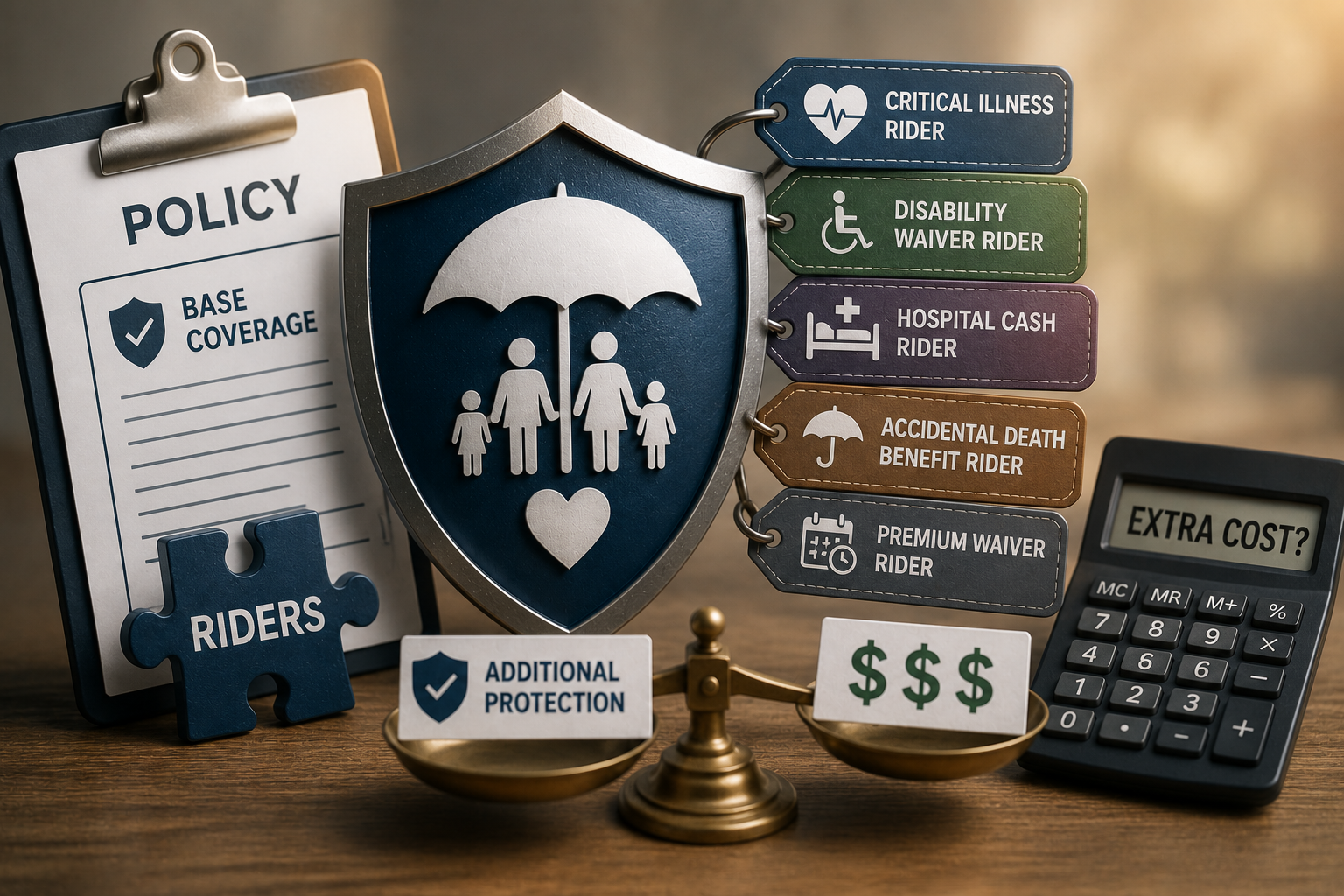
An accidental death rider (also called an accidental death benefit rider or double indemnity rider) is one of the most practical and affordable ways to boost your life insurance coverage against accident-related deaths. Rather than buying a separate AD&D policy, you add this rider to your existing term or permanent life policy for an additional monthly or annual premium.
How the Double Indemnity Rider Works
Here’s a straightforward example: You hold a $500,000 term life insurance policy with an accidental death benefit rider also valued at $500,000. You die in a qualifying accident. Your beneficiaries receive $500,000 from the base policy plus $500,000 from the rider, for a total of $1,000,000. If you die from a heart attack, they receive only the base $500,000.
Pro Tip
Accidental death riders typically add only a small amount to your monthly premium, often just a few dollars to a few tens of dollars depending on age and coverage amount, making them one of the highest-value additions you can make to a life insurance policy.
Other Common Riders to Know
Rider Name
What It Does
Best For
Accidental Death Benefit
Pays additional death benefit if death is accidental
Anyone seeking extra accident protection
AD&D Rider
Covers accidental death AND loss of limbs/senses
Manual laborers, outdoor workers
Waiver of Premium
Waives premiums if you become disabled due to accident
Primary breadwinners
Travel Accident Rider
Pays if death occurs during covered travel
Frequent business travelers
Accelerated Death Benefit
Allows living payout if terminally ill
Anyone wanting living access to benefit
7. 2026 Accidental Death Statistics in the U.S.
Understanding the scope of accidental death in America helps contextualize why this coverage matters and who is most at risk. Unintentional injuries have consistently ranked as one of the top causes of death in the United States, and the financial impact on families without adequate coverage can be devastating.
Top Causes of Accidental Death in the U.S. (2025 Data)
38% Poisoning / Drug OD
25% Motor Vehicle Accidents
20% Falls
9% Suffocation
8% Other Accidents
Source: CDC National Center for Health Statistics, 2025 data
U.S. Accidental Death Insurance Market Growth (2021 to 2026)
2026 Market Insight
The global accidental death insurance market is projected to reach $77 billion in 2026, growing at a compound annual growth rate of approximately 3.4%. North America remains the largest regional market, driven by rising consumer awareness of workplace and road accident risks.
8. How to File an Accidental Death Claim
Filing a life insurance claim after an accidental death involves more documentation than a natural-cause claim because insurers want to verify the accident occurred as described. Beneficiaries should act promptly but carefully to avoid mistakes that could delay or jeopardize the payout.
1
Obtain a Certified Death Certificate
You will need multiple certified copies from the county or state vital records office. Insurers require at least one certified original. The death certificate must indicate manner of death (accident, homicide, etc.) and cause of death clearly.
2
Locate the Insurance Policy Documents
Find the original policy, all riders, and any supplemental coverage documents. Note the insurer’s claims contact information, which is usually on the declarations page.
3
Notify the Insurer Promptly
Contact the insurance company’s claims department as soon as reasonably possible. Most policies do not have strict claim filing deadlines for death benefits, but early filing helps avoid complications.
4
Gather Supporting Documentation
For accidental deaths, this typically includes the official police or accident report, coroner or medical examiner report, medical records related to the accident and treatment, and witness statements if available.
5
Submit the Claim Form
Most insurers have a specific claim form for beneficiaries. Submit it along with all supporting documentation. Many major insurers like Guardian now allow online claim initiation, which can speed up processing.
6
Follow Up Regularly
State laws vary, but insurers generally must pay or deny a claim within 30 to 60 days of receiving all required documentation. If you are not hearing back, follow up proactively and document all communications.
9. What to Do If Your Claim Is Denied
Claim denials in accidental death cases are unfortunately not rare. Insurers may allege that the death resulted from an excluded cause, that the policy was not in force, or that the insured misrepresented information on the application. Understanding your rights is essential.
Important
If a claim is denied, you have the right to appeal. Do not accept a denial as final without reviewing the specific reason, consulting the policy language, and if necessary, retaining an attorney who specializes in insurance bad faith or ERISA claims (for employer-sponsored plans).
Steps After a Denial
Request the denial in writing with the specific policy exclusion cited. Review the policy language yourself to determine if the exclusion actually applies to your circumstances. Gather any additional medical evidence that supports the accidental nature of the death, such as the medical examiner’s complete report. Submit a formal written appeal to the insurer within the timeframe specified in your policy.
If the appeal is denied, you may have further remedies. For employer-sponsored group AD&D plans governed by ERISA, you can file a claim in federal court after exhausting internal appeals. For individual policies, you can file a complaint with your state’s Department of Insurance or pursue litigation. As of early 2026, insurance attorneys at firms tracking accidental death denials report that disputable cases often involve the precise manner-of-death classification used by the medical examiner, which can be grounds for re-examination.
10. 2026 News and Industry Updates
The accidental death insurance landscape has seen several notable developments in 2026, affecting how Americans purchase and use these policies.
The 2025 LIMRA Insurance Barometer study, accessed and cited by MetLife in May 2026, shows a significant increase in employer-sponsored AD&D enrollment, with supplemental employee-paid AD&D plans growing across mid-size and large employers.
March 2026
AD&D Market Research Confirms 41% Consumer Adoption
A comprehensive March 2026 market report from ReAnIn confirmed that roughly 41% of U.S. individuals now opt for policies designed to cover sudden and unexpected events, marking a multi-year high in accidental coverage adoption.
February 2026
MoneyGeek Publishes Updated AD&D vs. Life Insurance Guide
MoneyGeek released an updated comprehensive guide in February 2026 noting that while life insurance premiums remain higher due to broader coverage, AD&D policies are gaining traction as affordable supplements, particularly among consumers who do not qualify for traditional coverage.
January 2026
Legal Community Flags Increase in Disputed AD&D Claims
Insurance law firms including DeBofsky Law reported in early 2026 that disputed accidental death claims remain a meaningful source of litigation, particularly where the insured died from complications following an initial accident, with manner-of-death certification becoming a more frequently contested element.
June 2026
U.S. News Confirms Accidental Coverage Perk at Guardian and Mutual of Omaha
In June 2026 ratings published by U.S. News, both Guardian Life and Mutual of Omaha were highlighted for their accidental death benefit riders, with Mutual of Omaha offering standalone AD&D with up to $1 million in death benefit coverage, while Guardian emphasizes its streamlined online claims process for beneficiaries.
2026 Projection
Global Market Set to Hit $77 Billion
The accidental death insurance global market is on track to reach $77 billion in 2026, according to updated projections from market research published in February and March 2026, reflecting steady consumer demand and rising awareness of occupational and traffic hazards.
11. Frequently Asked Questions
Does life insurance pay double for accidental death? +
Not automatically. A standard life insurance policy pays the same benefit regardless of whether death is accidental or from illness. However, if you have added an accidental death benefit rider (sometimes called a double indemnity rider), the policy will pay an additional amount equal to the base death benefit if death is accidental. This effectively doubles the payout for qualifying accidents.
What is the difference between life insurance and AD&D insurance? +
Life insurance pays a death benefit for virtually any cause of death, including illness, accident, or natural causes (with limited exclusions). AD&D insurance pays a benefit only if death or serious injury results directly from a covered accident. AD&D is cheaper but provides far narrower protection and should generally supplement, not replace, a standard life insurance policy.
Will life insurance pay out if someone is killed in a car accident? +
Yes, in virtually all cases. Death in a car accident is a classic qualifying accidental death and will be paid under standard term and permanent life insurance policies. The only exception would be if the insured was committing a crime (such as vehicular manslaughter during a deliberate act) or if intoxication exclusions apply under the specific policy terms.
Does AD&D cover overdose deaths? +
It depends on the circumstances and the policy language. If the overdose involved a prescription medication taken as directed by a physician, most AD&D policies treat this as an accidental death and will pay the benefit. If the overdose involved illegal drugs or voluntary intoxication, most policies will deny the claim under the voluntary intoxication exclusion.
Is AD&D insurance worth it if I already have life insurance? +
For most people, yes, particularly if you work in a high-risk industry, drive frequently, or engage in physical outdoor activities. An AD&D rider is typically very affordable and provides meaningful extra protection. The dismemberment portion also covers scenarios that life insurance does not, such as losing a limb or your eyesight in an accident while you survive, giving you financial support during recovery.
How long does a beneficiary have to file an accidental death claim? +
There is generally no strict statutory deadline for filing a life insurance death benefit claim in the United States, but policies may contain their own notification provisions. More practically, filing sooner allows documentation to be gathered while it is still fresh and avoids complications. Some state laws require insurers to proactively notify known beneficiaries when they become aware of an insured’s death.
Does homeowners or renters insurance cover accidental death? +
No, homeowners and renters insurance do not provide life insurance death benefits. They may include personal liability coverage if someone else dies in an accident on your property due to your negligence, but they do not pay a death benefit to your beneficiaries if you die accidentally at home or anywhere else. A life insurance or AD&D policy is the correct product for that protection.
12. Final Verdict and Recommendations
The bottom line is clear: standard life insurance does cover accidental death, and for most American families, a solid term life insurance policy provides all the accident-related death coverage they need. The full death benefit is paid to beneficiaries whether you die from cancer, a car crash, a fall, or a workplace accident.
AD&D insurance serves a different, supplemental purpose. It becomes genuinely valuable when you want extra financial protection specifically for accident scenarios, when you want coverage for injury-related losses like loss of limbs or senses while you are still alive, or when you do not qualify for traditional life insurance due to health conditions and need at least some coverage for accident scenarios.
Here is a practical framework based on your situation in 2026:
Your Situation
Recommended Action
No life insurance at all
Buy term life insurance first. AD&D alone is not adequate family protection.
Have life insurance, want extra accident protection
Add an accidental death benefit rider to your existing policy for minimal cost.
Work in a high-risk industry (construction, mining, logging)
Add both an AD&D rider AND consider a standalone AD&D for dismemberment coverage.
Cannot qualify for traditional life insurance due to health
Standalone AD&D is a useful starting point, but explore guaranteed issue whole life as well.
Employer offers free group AD&D
Always enroll. It costs nothing and provides valuable supplemental coverage.
Frequent traveler or pilot
Review your policy exclusions carefully. Add a travel accident rider if needed.
Final Recommendation
The best strategy for most American households in 2026 is to carry a term life insurance policy as the foundation, supplemented by an affordable accidental death benefit rider. This combination ensures your family is protected against all major causes of death while giving them an extra financial cushion in the event of a qualifying accident. Review your policy documents, understand your exclusions, and consult a licensed insurance professional if your circumstances are complex.