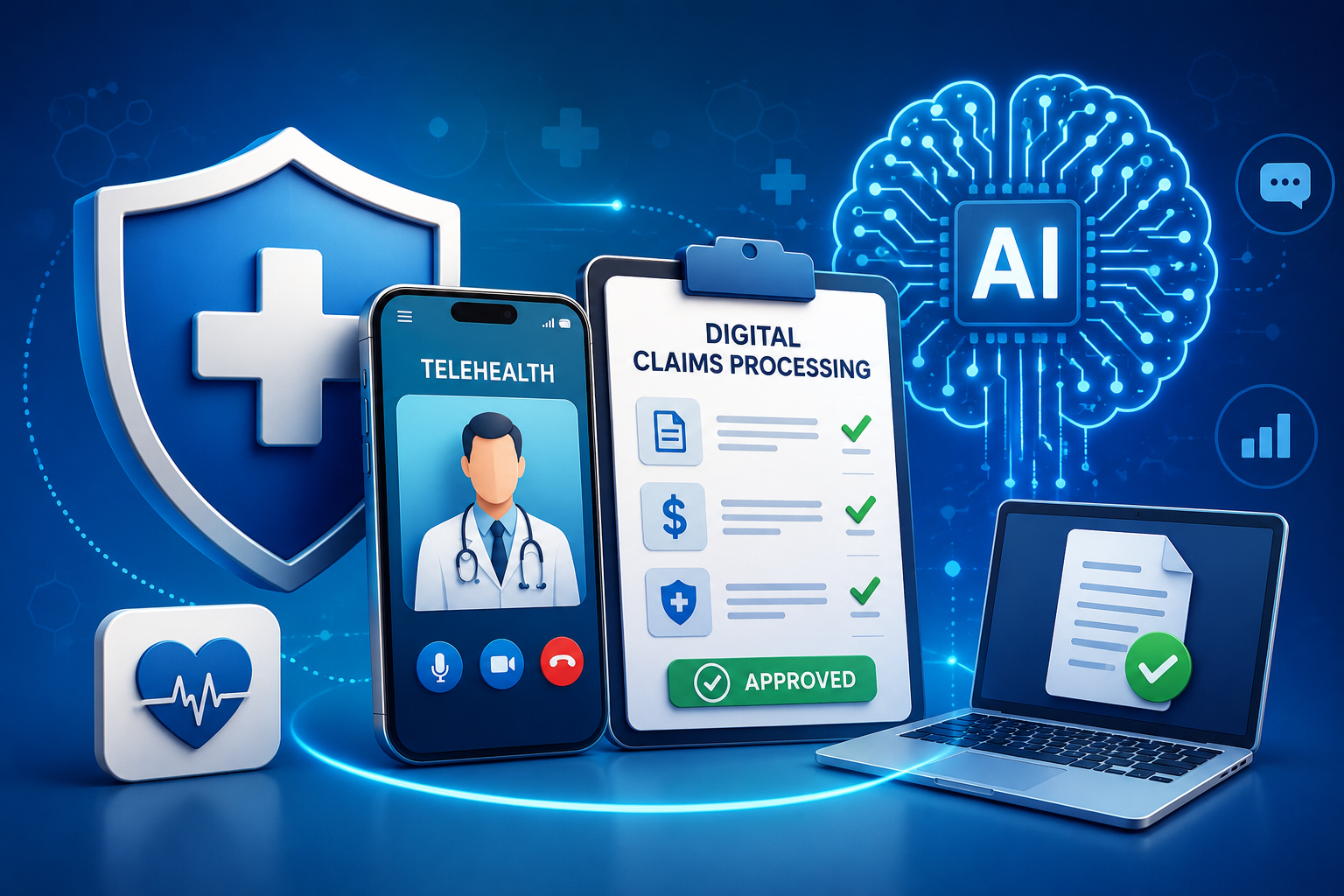
The modern health insurance ecosystem is undergoing a profound structural shift. Driven by skyrocketing operational expenses, an administrative baseline vulnerable to human error, and evolving consumer expectations, legacy systems are rapidly being phased out. Payers are transitioning away from slow, manual processing models toward fully digital, interconnected ecosystems.
This transformation is anchored by three primary technology drivers: artificial intelligence, expanded telehealth networks, and straight-through automated claims engine optimization. Together, these technologies are reshaping risk underwriting, restructuring patient care coordination, and accelerating reimbursement schedules. For consumers, policyholders, and human resource directors, understanding this systemic realignment is essential for managing coverage and containing costs.
1. The Artificial Intelligence Revolution in Payer Operations
Artificial intelligence has evolved past the conceptual and pilot testing phases to become the fundamental operational infrastructure for enterprise insurance organizations. Carriers are utilizing machine learning, deep neural networks, and agentic AI models to optimize back-office operations and improve decision accuracy.
Automated Fraud, Waste, and Abuse Detection
According to the National Health Care Anti-Fraud Association, healthcare fraud costs the industry tens of billions of dollars annually. Traditional post-payment auditing systems rely on human analysts to manually spot billing anomalies, meaning patterns are often uncovered months after payouts occur.
Modern predictive AI software prevents this financial leakage by auditing claims in real time prior to disbursement. Anomaly detection models score inbound provider billing files against historical peer behavior, patient diagnostic profiles, and clinical guidelines. If a hospital bills an implausible combination of treatment codes, the machine learning system immediately routes the file for clinical validation, reducing false-positive flags by approximately 25% while keeping overall verification accuracy above 90%.
Algorithmic Underwriting and Real-Time Risk Profiling
Traditional health insurance underwriting evaluates risk through broad, historical demographic cohorts, which can result in imbalanced risk pooling and inaccurate premium assignments.
Advanced AI underwriting tools process multi-dimensional data models, including anonymized electronic health records, continuous biometrics from smart wearables, and environmental lifestyle metrics. This multi-layered analysis allows plans to establish highly accurate, personalized risk profiles.
This optimization is particularly critical as overall commercial medical spending trends reach post-pandemic highs of 8.5% to 9.0%. These increases are driven by rising care costs and provider adoption of AI-enabled documentation tools that maximize billable diagnostic intensity. To maintain premium stability, insurers use real-time risk analytics to design targeted plan structures rather than relying on broad, retroactive premium increases.
2. Advanced Telehealth Integration and Virtual-First Care Delivery
Virtual care delivery has expanded from an occasional alternative for rural communities into a core strategic framework for commercial insurance design.
The Rise of Virtual-First Health Plans
Virtual-First Health Plans (VFHP) establish a digital interface as the primary point of entry for patient care. Except for immediate physical emergencies, members consult virtually with a digital primary care group before receiving referrals for in-person specialist evaluations.
This digital triage framework reduces unmanaged specialist self-referrals and diverts low-acuity cases away from expensive emergency rooms. Because operational overhead is lower, virtual-first plans frequently pass savings along to consumers, featuring monthly premiums 15% to 20% lower than traditional managed-care policies.
Shifting Federal and Private Payer Regulations
The digital health market is expanding rapidly, with projections indicating it will reach $101.72 billion by 2034, up from $48.15 billion. This sustained growth is accelerating integration between private and public insurance plans.
While public coverage policies face ongoing regional shifts, federal updates have extended crucial Medicare telehealth flexibilities through December 31, 2027. This extension maintains broad geographic originating site exceptions, allows for continuous home-based virtual visits, and preserves audio-only consulting reimbursements for vulnerable populations. Concurrently, private health organizations are expanding their independent virtual networks to manage complex, chronic illnesses through remote patient monitoring devices, including connected continuous glucose monitors and cellular blood pressure cuffs.
3. Straight-Through Processing and Digital Claims Automation
The most immediate operational cost reduction stems from the elimination of manual claims handling through Straight-Through Processing (STP). STP refers to claims that flow seamlessly from the provider’s initial clearinghouse transmission through validation rules directly to electronic fund transfer settlement, requiring zero manual human intervention.
The Automated Claims Maturity Curve
Modern claims automation progresses through distinct, evolutionary stages as a carrier upgrades its core infrastructure:
Automation Tier
Core Technological Infrastructure
Realized Processing Velocity Impact
Average Cost Reduction Per Unit
Level 1: Task Automation
Optical Character Recognition (OCR), basic database input scripts.
Form text input settles in 2 to 3 business days.
5% to 10% administrative cost reduction.
Level 2: Workflow Automation
Fixed, rules-based algorithmic routing; automated status messaging.
Verification clears file checks within 24 hours.
15% to 25% administrative cost reduction.
Level 3: Intelligent Orchestration
Agentic AI processing, predictive validation, real-time fraud scoring models.
Settlement finalizes within seconds of provider submission.
35% to 50% administrative cost reduction.
Real-Time Validation via Deep Learning and Smart Ledgers
By integrating computer vision models and deep learning engines, automated claims systems can evaluate unstructured data, such as diagnostic imaging files, laboratory printouts, and complex operative notes. The system validates the medical necessity of a procedure against a member’s active policy terms in seconds, reducing human handling time by more than 60%.
To secure these transactions, leading insurers are deploying private, permissioned blockchain networks. These encrypted digital ledgers provide an immutable record of clinical documentation, preventing duplicate bill submissions and coordinating cross-carrier benefits instantly when a patient carries multiple insurance policies.
4. Visualizing the Projected Financial Shift
The financial impact of this digital evolution is evident in shifting administrative overhead and overall marketplace valuations. The following visualization illustrates the projected expansion of the global artificial intelligence insurance claims market through 2034, highlighting the industry’s widespread transition toward automation.
Global AI Insurance Claims Automation Market
Projected market capitalization scale and administrative processing cost reductions through 2034.
While the integration of these digital platforms improves back-office efficiency, transitioning to fully automated systems introduces distinct challenges that must be addressed.
Structural Benefits
Accelerated Payout Turnaround: Transitioning to straight-through processing eliminates the multi-week waiting periods traditional claims require, resolving claims up to 75% faster.
Minimized Overhead Costs: Replacing manual processing loops with automated triage models reduces unit processing costs by 30% to 40%.
Lower Consumer Premium Tiers: Lower operational expenses allow payers to offer more affordable coverage options, such as digital-first plan structures.
Operational Challenges
Heightened Data Vulnerability Risks: Consolidating electronic health records, financial data, and live biometric feeds into connected cloud databases increases the system's exposure to cybersecurity threats.
Algorithmic Bias and Automated Denials: If machine learning models are trained on flawed historical data, they can introduce systematic biases, leading to incorrect, automated care denials that require manual appeal paths.
Implementation Complexity: Migrating legacy monolithic enterprise databases to composable, cloud-native API structures requires substantial upfront capital and complex integration timelines.
Summary and Outlook
The future of health insurance depends on the successful integration of automated, data-driven technologies. As artificial intelligence optimizes underwriting models, telehealth establishes more efficient care pathways, and digital claims engines automate administrative processing, the traditional health insurance framework is being completely re-engineered.
For industry stakeholders, these advancements offer a path to counter inflationary healthcare trends. Category leaders will be defined by their ability to successfully deploy interconnected digital ecosystems that deliver rapid, transparent, and accurate coverage decisions.