Purchasing your first home is an milestone that represents years of disciplined saving, endless property viewings, and complex financial calculations. In the excitement of signing the contract, choosing paint colors, and planning your move, it is easy to treat homeowners insurance as a minor administrative detail: a simple document you rush to secure at the last minute just to satisfy your mortgage lender’s closing requirements.
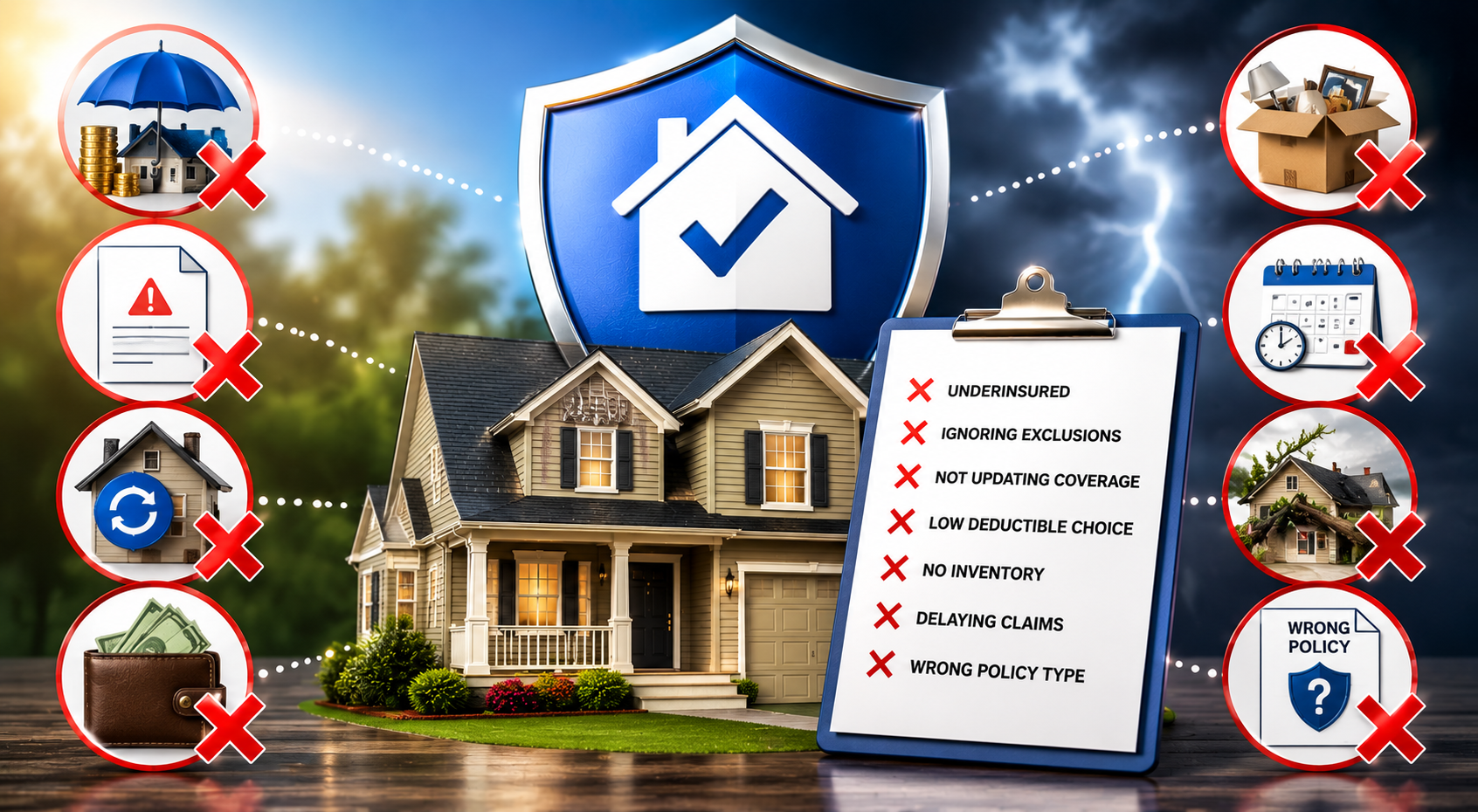
This is a dangerous and costly mistake. The property insurance market is navigating a period of unprecedented volatility. Driven by high construction material costs, skilled labor shortages, and an increase in severe weather events, securing the right home insurance policy is no longer a passive transaction.
According to recent industry data from the NAIC Consumer Protection Portal, property premiums have climbed significantly over the last three years, with insurance costs now accounting for a larger portion of a homeowner’s monthly housing budget than ever before.
For a first-time homebuyer, stepping into this environment without a clear plan can lead to two severe outcomes: overpaying by thousands of dollars over the life of your mortgage, or unknowingly holding a policy riddled with hidden gaps that leave you financially exposed if a disaster occurs.
This comprehensive guide will strip away the confusing industry jargon, break down the core components of property protection, explain how the mortgage escrow process manages your money, and deliver a step-by-step blueprint to secure the highest-quality coverage at the lowest possible cost.
1. What is Homeowners Insurance and Why Do You Need It?
Homeowners insurance is a legally binding contract between you and an insurance carrier. In exchange for a regular monthly or annual fee (called the premium), the insurance provider agrees to cover the financial cost of repairing or rebuilding your home and replacing your personal belongings if they are damaged or destroyed by a covered disaster (called a peril).
While you might understand that insurance is vital, first-time buyers often ask: is it actually required by law?
The short answer is no: there is no state or federal law that mandates homeowners insurance. However, if you are like the vast majority of buyers and are using a bank or financial institution to finance your home purchase, your mortgage lender will absolutely require active, sufficient coverage before they fund your loan.
To a lender, your home is the primary collateral for their investment. If the house burns down next week, the bank needs to know that there is a secure source of capital available to rebuild the structure and restore the value of their security. If you let your policy lapse, your lender has the legal right to purchase a highly expensive, low-quality alternative called “force-placed insurance” and bill you for it, or even declare your loan in default.
Beyond satisfying your lender, home insurance is your primary tool for personal wealth protection. It is designed to safeguard your largest financial asset, protect your personal possessions, and shield your savings from devastating liability lawsuits.
2. The Core Package: HO-3 Policy Coverage Areas Explained
Most standard home insurance policies issued to single-family homeowners are written on an HO-3 policy form. This is a packaged policy that groups six distinct coverage areas together. Understanding these six divisions is crucial to auditing any quote you receive.
Coverage A: Dwelling
This is the core of your policy. It pays to repair or completely rebuild the physical framing, walls, roof, foundations, and built-in fixtures of your home if they are damaged by an open list of covered perils, such as fire, windstorms, hail, lightning, and explosions.
Coverage B: Other Structures
This covers detached structures situated on your property lot. Examples include fences, detached garages, tool sheds, guest houses, and gazebos. Standard policies usually set this limit automatically at 10% of your Coverage A limit, though this can be manually adjusted upward if you have extensive outbuildings.
Coverage C: Personal Property
This protects your personal belongings: the items inside the house that would fall out if you could turn it upside down. It covers furniture, clothing, electronics, sports equipment, and kitchen appliances. This protection is portable, meaning your items are covered even if they are stolen from your hotel room or car while you are traveling.
Standard coverage limits are typically set between 50% and 70% of the Coverage A limit. High-value items like jewelry, fine art, collectibles, and firearms are subject to strict sub-limits (often capping payouts at $1,500 per category) unless they are scheduled separately.
Coverage D: Loss of Use (Additional Living Expenses)
If a covered fire or storm renders your home completely uninhabitable while repairs are being made, Loss of Use coverage steps in to handle the extra costs. It pays for hotel bills, temporary apartment rentals, restaurant meals, moving storage fees, and laundry costs, ensuring your family can maintain its standard of living without facing immediate financial distress.
Coverage E: Personal Liability
This protects your household savings and future earnings if someone files a lawsuit or makes a claim against you for bodily injury or property damage occurring on your premises. For example, if a guest slips on your icy driveway or your dog bites a visitor at a backyard gathering, this coverage funds your legal defense team and pays any court-ordered settlements up to your policy limit.
Coverage F: Medical Payments to Others
This is a small, no-fault medical coverage designed to handle minor guest injuries quickly and quietly. It pays for small-scale medical costs, such as x-rays, dental work, or stitches, if a visitor is accidentally injured on your property, regardless of who was at fault. Handling small incidents this way often prevents them from turning into larger liability lawsuits.
3. The Rebuild Value vs. Market Value Trap
The most common and dangerous mistake first-time homebuyers make is assuming that their home insurance policy should match their home’s real estate market value or purchase price.
Your purchase price is heavily influenced by non-physical factors, including neighborhood desirability, local school districts, proximity to major transit lines, and land values. An insurance carrier, however, does not care about the land your home sits on: land cannot burn down, get stolen, or blow away in a storm.
Underwriters care exclusively about the reconstruction cost: the real-world cost of raw physical materials (wood, concrete, shingles, wiring) and local construction labor required to clear debris and rebuild your house from the ground up to modern building standards.
If you buy a historic home in an expensive metropolitan area, your purchase price might be $750,000, but the actual physical cost to rebuild it using standard modern materials might only be $450,000. In this case, insuring the home for $750,000 means you are overpaying on premiums for coverage you can never legally collect.
Conversely, if you purchase a home in a highly affordable suburban area for $200,000, but supply chain pressures and labor shortages have driven local rebuilding costs to $350,000, insuring the home for your purchase price of $200,000 leaves you severely underinsured. If a total fire occurs, your policy limit will run out long before the house is finished, leaving you facing a massive financial gap.
The Math of Depreciation and Value Modeling
To understand how your policy will pay out during a claim, you must understand the difference between Actual Cash Value (ACV) and Replacement Cost Value (RCV).
Actual Cash Value (ACV): ACV calculates claim payouts based on the item’s current depreciated value at the time of loss.
Replacement Cost Value (RCV): RCV covers the actual, real-world cost to purchase a brand-new equivalent item or rebuild the structure using new materials of comparable quality, without deducting for age or wear.
The mathematical formula used by insurance adjusters to calculate an ACV payout is:
As a first-time buyer, you should always ensure your policy dwelling coverage (Coverage A) and personal property coverage (Coverage C) are written on a Replacement Cost basis to protect your personal savings from severe depreciation gaps.
Model your complete monthly housing budget, verify recommended structural safety limits, and simulate the exact pre-paid insurance reserves required on closing day.
1. Purchase & Financial Parameters
The agreed real estate purchase contract price. Dictates down payment metrics and lender loan limits.
Down payments under 20% require lender Private Mortgage Insurance (PMI) fees.
Crucial! The actual cost of labor and building supplies. Sets your Coverage A Dwelling limit.
Strategy #1: Selecting a higher deductible drops your annual insurance premium costs.
Coverage B (Other Structures – 10% automatically):$0
Coverage C (Personal Property – 50% automatically):$0
Coverage D (Loss of Use – 20% automatically):$0
Executing underwriting model calculations…
4. Key Policy Exclusions: What Standard Policies Do Not Cover
Standard homeowners insurance policies provide excellent coverage for everyday disasters, but they are not unlimited safety nets. Standard policies feature several major exclusions. Knowing what is excluded allows you to purchase separate coverage to stay fully protected.
Disaster Category
Standard Policy Status
Corrective Planning Action
Rising Flood Waters
Completely Excluded
Secure separate coverage through the National Flood Insurance Program (NFIP) or private markets.
Earthquakes & Shaking
Completely Excluded
Add a specific Earthquake Endorsement or buy a standalone policy.
Sewer & Drain Backups
Completely Excluded
Purchase a dedicated Sewer and Water Backup endorsement.
General Neglect & Wear
Completely Excluded
Perform routine home maintenance (cleaning gutters, checking pipes, maintaining roofs).
Flood Damage
Many first-time buyers are shocked to learn that standard homeowners insurance provides zero coverage for damage caused by rising surface water, overflowing rivers, storm surges, or heavy rainfall that pools outside and enters the home. Even if your lender does not require flood coverage because your home is located outside a designated high-risk zone, securing separate flood insurance is highly recommended.
According to data from FEMA’s flood risk education portal, over 20% of all flood claims occur in low-to-moderate-risk areas, making it a critical consideration for every homeowner.
Sewer and Water Backup
If a municipal sewer line blocks or your home’s sump pump fails, sending toxic wastewater back up through your basement drains, a standard home insurance policy will not cover the resulting cleanup or repair costs. Fortunately, most carriers allow you to add a Sewer and Drain Backup Endorsement to your policy for a modest annual fee. This add-on is highly recommended if your home has a finished basement or a sump pump system.
Earthquake and Earth Movement
Standard policies exclude damage from earth movement, including earthquakes, landslips, mudslides, and sinkholes. If your new home is situated near active fault lines, work directly with your independent broker to secure a specialized earthquake policy or a specific earthquake endorsement to protect your equity.
5. How the Mortgage Escrow Process Works
When you finalize your home purchase on closing day, your monthly mortgage payment will likely consist of four distinct parts: Principal, Interest, Taxes, and Insurance. This structure is commonly referred to in the lending industry as PITI.
To make sure your property taxes and home insurance premiums are paid on time, your mortgage lender will set up a specialized holding account called an escrow account.
Each month, a portion of your total mortgage payment is automatically directed into this escrow account. When your annual property taxes and home insurance premiums come due, your mortgage servicer pays those bills directly to the county tax assessor and your insurance company using the funds in your escrow account.
On closing day, your lender will require you to pay the first full year of your home insurance premium upfront, plus an extra cushion equal to two months of premiums. This initial payment is called an escrow pre-paid cost. It ensures that your escrow account always has enough capital to pay your next annual bill on time, even if premium rates rise.
Every year, your mortgage servicer will run an escrow analysis to verify your account balance. If your home insurance premium or property taxes increase, your monthly mortgage payment will adjust upward to cover the higher costs and prevent an escrow shortage.
6. Actionable Blueprint: How to Save Money Without Weakening Coverage
As a first-time homebuyer, you do not have to accept the first insurance quote your lender or real estate agent suggests. You can use several strategic, data-backed planning methods to lower your premium costs while keeping your structural protection completely intact.
Strategy 1: Adjust Your Deductible Strategically
Your deductible is the initial, out-of-pocket amount you agree to pay toward a covered repair before your insurance provider covers the remaining balance. Standard deductibles typically default to $500 or $1,000.
Increasing your standard all-peril deductible to $2,500 or $5,000 can lower your annual premium costs. This adjustment signals to your insurance carrier that you are highly unlikely to file small, minor claims, which drops your baseline premium.
To make this strategy work, treat your insurance policy as a shield against major, life-altering financial disasters, not as a general maintenance plan. Save the premium savings you capture each month in a dedicated home emergency fund to handle minor repairs out of pocket.
Insurance companies use various automated discounts to attract stable, low-risk clients. When shopping for coverage, verify that your agent has applied these key discount options:
The Multi-Policy Bundle: Placing your automobile, motorcycle, boat, or personal umbrella policies under the same corporate umbrella as your home insurance remains the single most effective multi-line pricing discount, routinely lowering your total bill by 15% to 25%.
Annual Paid-in-Full Modifications: If your budget allows, shifting your premium payment frequency from monthly installments to a single lump-sum annual payment completely removes hidden administrative processing fees and typically triggers an immediate discount.
Paperless and Auto-Pay Enrollment: Opting for digital policy delivery and automatic electronic bank drafts takes only minutes to configure but consistently lowers your annual premium.
Strategy 3: Leverage Home Hardening and Mitigation Features
Modern underwriting engines use high-resolution satellite imagery, drone data, and automated algorithms to analyze your property’s specific physical risks. Taking proactive steps to improve your home’s structural resilience can yield immediate premium savings:
Upgrade Your Security Tech: Installing professionally monitored home security alarms, integrated smart smoke sensors, and smart water leak detection shut-off valves directly reduces the likelihood of severe damage, prompting carriers to offer lower rates.
Audit Your Roof’s Resilience: Your roof is your home’s first line of defense against severe weather. Upgrading to impact-resistant shingles or securing a wind-mitigation inspection can trigger significant premium discounts.
Update Legacy Utilities: If you are purchasing an older home, updating outdated knob-and-tube wiring, copper plumbing, or older electrical panels directly lowers your risk profile, helping you qualify for more competitive premium rates.
Strategy 4: Partner with an Independent Broker
Avoid buying insurance directly from a “captive agent” who works exclusively for a single brand. Captive agents can only offer policies from their specific company, which limits your options.
Instead, partner with an independent insurance broker. Independent brokers have access to multiple insurance platforms simultaneously. They can shop your unique health, financial, and property profile across dozens of competing carriers, finding the company whose underwriting rules are most favorable for your specific background.
7. The First-Time Homebuyer’s Closing Checklist
To make sure your closing day goes as smoothly as possible, use this step-by-step home insurance checklist:
Obtain Your Home’s Rebuild Cost: Work with your independent broker to run a professional replacement cost calculation to determine your true Coverage A Dwelling limit.
Compare At Least Four Quotes: Shop your coverage across multiple competing carriers to ensure you are securing the most competitive rates.
Verify Replacement Cost Endorsements: Confirm that both your Dwelling (Coverage A) and Personal Property (Coverage C) are written on a Replacement Cost basis.
Add Crucial Endorsements: Evaluate your need for key add-ons, including Sewer and Drain Backup, Ordinance or Law, and separate Flood Insurance.
Provide Your Quote to Your Mortgage Lender: Share your chosen home insurance binder and invoice with your loan officer at least 10 days before closing to prevent funding delays.
Confirm Your Escrow Pre-Paid Setup: Review your closing disclosure documents (specifically Section G) to confirm your first full year of premiums has been correctly factored into your pre-paid closing costs.
Summary and Key Takeaways
Homeowners insurance is much more than a mandatory mortgage checklist item. It is a vital financial safety net designed to protect your largest personal asset, shield your family’s savings, and secure your long-term peace of mind.
By understanding the six core coverage areas, matching your policy limits directly to your home’s physical reconstruction cost, and taking advantage of structural discounts and deductible strategies, you can build a highly effective, affordable safety net that protects your property for years to come.