Every time you hit the road, you share the asphalt with distracted drivers, tailgaters, and unexpected road hazards. It is no surprise that dashboard cameras, commonly known as dashcams, have exploded in popularity among everyday motorists.
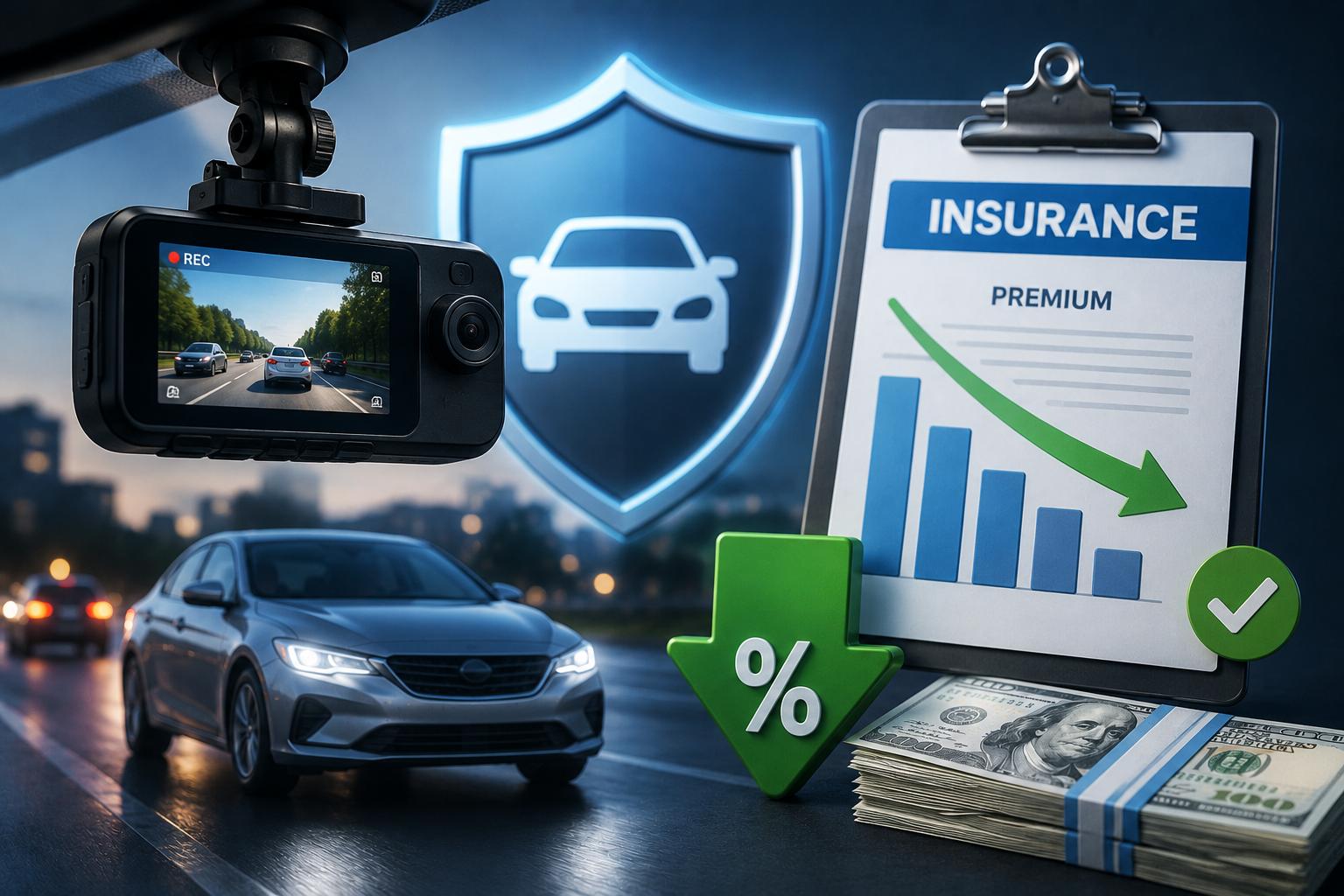
As drivers look for ways to protect themselves from financial liability, a vital personal finance question arises: Can installing a dashcam actually lower your auto insurance premiums?
The intersection of dashboard technology and insurance underwriting is shifting fast. While some drivers expect an immediate, line item discount the moment they plug in a front facing camera, the real world financial impact is more nuanced.
This deep dive covers the current market realities of dashcam insurance discounts, how video evidence alters your risk profile, and why a camera can save you thousands of dollars even if your insurer does not offer a direct premium price cut.
The Direct Premium Discount Reality Check
Let us tackle the most common misconception right away. In major insurance markets like the United States and Australia, the vast majority of consumer auto insurance providers do not offer an automatic, upfront discount just for having a dashcam installed.
If you call major carriers like Progressive, State Farm, or Allstate to report you bought a retail dashcam, your base monthly premium quote will generally remain unchanged.
However, the global market is highly fragmented, and change is underway:
The Australian Footprint: Recent marketplace research by comparison groups like Compare the Market reveals that roughly 20 percent of surveyed auto insurers have begun incorporating dashcams into their premium scoring models. Across regions like Queensland, Victoria, and New South Wales, drivers using verified dashcams secured modest direct premium discounts averaging between 3.8 percent and 4.6 percent.
The United Kingdom Baseline: The UK market sits roughly three to five years ahead of the US and Australia regarding hardware integration. Top tier UK insurers like Aviva and LV regularly extend explicit premium discounts ranging from 10 percent to 25 percent for motorists who install approved, calibrated, cloud connected camera systems.
The Commercial Sector: For commercial fleets and logistics companies, the rules are entirely different. Fleet insurers routinely slash annual coverage costs by up to 30 percent when businesses pair dual facing smart cameras with integrated telematics tracking systems.
Why Most Consumer Insurers Hesitate to Give Upfront Discounts
Insurance underwriting is built entirely on mathematical risk allocation. Actuaries look at data to determine if a specific safety feature reduces the probability of an accident occurring.
Features like automatic emergency braking (AEB), lane keep assist, and electronic stability control actively intervene to prevent collisions, earning them built in policy discounts.
A dashcam, by contrast, is a passive recording device. It does not stop a distracted driver from rear ending you at a red light. Because a camera does not physically lower the statistical likelihood of an impact, consumer insurers rarely reward its presence with an immediate price cut.
Dashcam Long-Term Savings Calculator
See how much money you save by using video evidence to prevent a multi-year at-fault insurance surcharge.
Your Policy Parameters
$2,000
$500$5,000
47%
15% Mild Spike60% Severe Penalty
No Dashcam (Disputed Fault)
Hardware Layout Cost:$0
Out-of-Pocket Deductible:$500
Yearly Premium Surcharge:$940
Total Accumulated Surcharges:$2,820
Total Financial Exposure:$3,320
With Dashcam (Proved Innocent)
Hardware Baseline Cost:$150
Out-of-Pocket Deductible:$0
Yearly Premium Surcharge:$0
Total Accumulated Surcharges:$0
Total Financial Exposure:$150
Loading savings calculations…
The Hidden ROI: How Dashcams Save You Money Indirectly
Even if your auto insurance policy dashboard does not feature a dedicated dashcam discount check box, owning a camera remains one of the smartest investments you can make to protect your bank account. The true financial return on investment (ROI) occurs after an incident takes place.
1. Defeating the At-Fault Rate Surcharge
This is where a dashcam pays for itself many times over. When you are involved in an accident where fault is contested, it becomes your word against theirs. If the insurance companies settle on a 50/50 split liability decision due to a lack of independent evidence, your insurer views you as a higher risk.
According to long term marketplace rate tracking by groups like Insurify, a single at-fault accident designation triggers an average car insurance premium spike of 47 percent at your next renewal cycle.
This high risk surcharge typically shadows your policy profile for three to five years. Clear, high definition video footage wipes away ambiguity, proves your innocence to claims adjusters, and protects your clean driving record from these multi year premium hikes.
2. Immediate Claims Resolution Speed
A traditional car insurance claim with conflicting driver statements can easily drag out between 45 and 90 days as adjusters interview witnesses, review police reports, and wait for subrogation sequences.
During that multi week window, you might be forced to pay out of pocket for rental cars, vehicle storage fees, or upfront medical bills.
When you submit unambiguous, date stamped dashcam footage right after a crash, the entire evaluation timeline condenses. Insurers representing the at-fault party often accept total liability within 24 to 72 hours when faced with undeniable video proof, saving you months of financial stress and out of pocket bridge costs.
3. Evading Deductibles and Excess Fees
If you cannot definitively prove that another driver caused an accident, you are usually forced to file a claim under your own collision coverage to get your car repaired quickly. This means you must pay your policy deductible, which typically ranges from $500 to $1,000.
With clear video evidence validating the other driver’s fault, your insurer can fast track the recovery process against the negligent party’s carrier, allowing them to waive or quickly refund your out of pocket deductible.
The Hidden Financial Math of Car Insurance Surcharges
To see the real world numbers, let us analyze a financial cost scenario. Imagine you pay a standard premium of $2,000 per year. The table below outlines your total out of pocket financial footprint over a three year period following a disputed intersection collision.
We compare a driver without a dashcam (who gets hit with a 50/50 split fault ruling) against a driver with a dashcam (who uses video to prove 100 percent innocence).
Three-Year Cost Impact of a Disputed Accident
Financial Component
Driver Without Video Evidence
Driver With Active Dashcam
Initial Camera Hardware Cost
$0
$150 (One-time purchase)
Immediate Out-of-Pocket Deductible
$1,000 (Forced to use own policy)
$0 (Waived via third-party fault)
Year 1 Insurance Renewal Cost
$2,940 (Includes 47% rate surcharge)
$2,000 (Maintains clean record)
Year 2 Insurance Renewal Cost
$2,940 (Surcharge persists)
$2,000
Year 3 Insurance Renewal Cost
$2,940 (Surcharge persists)
$2,000
Total Cumulative 3-Year Expense
$9,820
$6,150
Interactive Insurance Surcharge Calculator
Use this interactive tool to calculate how much money an active dashcam can save you by helping you dodge post accident insurance rate spikes. Adjust the parameters to fit your current premium and deductible structure.
Protecting Yourself from Cash-for-Crash Staged Accident Fraud
A growing risk on modern roadways is the organized staged accident phenomenon, often referred to by law enforcement as cash for crash fraud. Fraud rings deliberately target innocent drivers by executing aggressive maneuvers designed to force an unavoidable collision.
The most common iteration is the swoop and squat maneuver:
An accomplice vehicle cuts off a lead fraud car.
The lead fraud car slams on its brakes violently for no legitimate reason.
You rear end the fraud car because you do not have enough stopping distance.
In the eyes of traditional traffic law, a rear end collision carries a nearly unbreakable presumption of fault for the trailing driver. Fraudsters exploit this rule to stick your insurance provider with massive bills for vehicle damage and fabricated soft tissue whiplash injuries, costs that are ultimately passed straight back to you via increased regional insurance premiums.
A dashcam completely derails this criminal playbook. By providing high frame rate footage showing the erratic behavior, coordinated brake light execution, and intentional setup patterns of the vehicles ahead, you give your insurer’s special investigative unit the definitive tools required to deny the fraudulent claim entirely.
Action Plan: How to Maximize the Insurance Value of Your Dashcam
Simply buying a cheap camera and sticking it on your windshield is not enough to secure your financial safety net. To ensure your video evidence stands up during a high stakes insurance dispute, follow this strict operational checklist:
Step 1: Choose the Right Hardware Specifications
Avoid generic, unbranded cameras with poor nighttime resolution. Look for a system that features a Sony STARVIS sensor or equivalent low light optimization. Your camera must capture clear footage at a minimum resolution of 1080p at 30 frames per second, though 2K or 4K resolution is highly preferred for capturing legable license plate characters from a distance. Consider a dual channel setup that includes a discrete rear facing camera to defend against rear end liability claims.
Step 2: Enable Crucial Telematics Metadata
When configuring your dashcam system settings, make sure the automatic overlay options for GPS location coordinates and speed tracking are turned on. Having your exact speed embedded directly onto the video file removes any subjective arguments from opposing claims adjusters regarding whether you were exceeding the posted speed limit before impact.
Step 3: Master Post-Accident Data Management
If you get into a collision, do not let the camera continue to run indefinitely. Most modern dashcams utilize loop recording, meaning the device continuously overwrites the oldest video files on the microSD card as space runs out.
Press the manual emergency lock button on your device instantly to quarantine the critical accident file. Remove the memory card entirely once it is safe to pull over, and back up the raw video files immediately to a secure cloud storage folder or your smartphone app.
Conclusion: An Essential Layer of Financial Defense
While the consumer insurance market in 2026 has not yet made automatic dashcam premium discounts standard across the board, evaluating a camera based solely on an upfront discount misses the bigger financial picture.
A dashcam functions as a highly effective insurance policy for your actual insurance premium. By keeping your driving record clean, accelerating claims resolutions, throwing out fraudulent liability demands, and protecting your out of pocket deductible, a dashboard camera easily proves its worth on modern roads.